


Soul-itude – Matthew 11:25-30
What do you think of when you hear the word rest?
I’ll bet some of you think of this:

Jesus says, “Come to me, all of you who are weary and carry heavy burdens, and I will give you rest.”
That’s a comforting verse. Why do we need rest? What is it that makes us tired?
We all might answer that differently, but many of our answers are probably some form of work. Jesus says, “Take my yoke upon you . . .” A yoke sounds like work.
This is a yoke on two oxen:

This is a yoke for people carrying stuff: [2]

This is a yoke for breakfast:

Did you know that this ↓ is also a yoke?
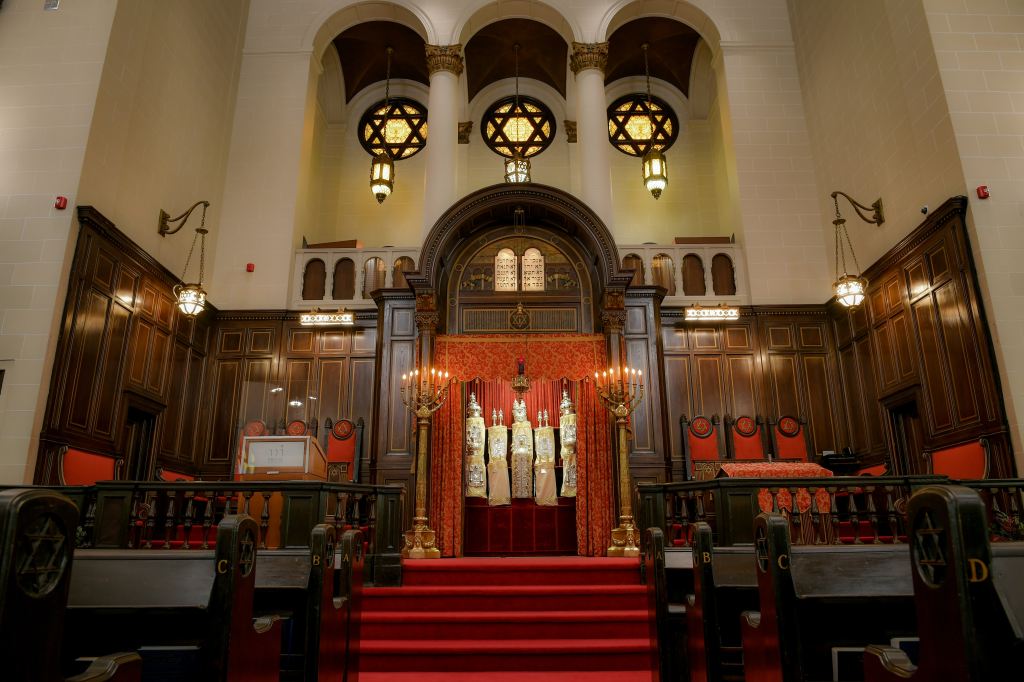
[3]This picture shows the inside of a synagogue, and those white things in the middle are the scrolls of the Torah. The rabbis taught that people should submit to the yoke of the Torah, a metaphor for service to God.[4] But the yoke of the Torah had become heavy with all the expectations and rules that went with it.
So when Jesus says, “Take MY yoke upon you…” he is using a metaphor the people already knew and, in a sense, turning it upside down. (So the yoke’s on us.)
But how could a yoke bring rest?
If the yoke is not a wooden contraption for carrying things, but is instead the Torah, the word of God, and Jesus is the word incarnate, the word made flesh, and through Jesus we have the Holy Spirit who lives in us, then we carry the word of God, we carry Jesus in hearts. That doesn’t sound so much like work, does it?
Or does it? Does carrying Jesus in your heart sound hard?
It can be. Why would it be hard?
- Trying to be perfect
- Trying to be good enough
Maybe it depends how we think about it. Earlier in Matthew, we’re told that John the Baptist and Jesus were telling people to “repent for the kingdom of heaven is at hand.”
The Greek word that gets translated as repent is metanoia. When the gospels were first translated from Greek into Latin, the Latin word the translator used was paenetere, which means to cause or to feel regret. Paenetere in English is penitence. The church began to institutionalize the process of penitence, repenting and doing penance. So the idea of metanoia as repentance stuck.
Tertulian, one of the early church leaders, argued that metanoia was better translated as changing one’s mind. That’s what metanoia literally means – meta means change, noia is think, and many scholars since Tertulian agree, but our way of thinking about this word and its implications are so entrenched that it’s been difficult to change the way we think about it…somewhat ironically. Martin Luther took issue with the translation of metanoia as repentance in his arguments with the church of his time, and his arguments were foundational to the 95 theses for which he became famous.
Some say that church leaders prefered the idea of repentance, because people are more easily motivated by fear. It is the base emotion that so many advertisers and politicians use to get us to buy their products or to vote for them. But does it make sense that this would be the way of Jesus? Jesus said, “Let not your hearts be troubled, neither let them be afraid.” (John 14:27)
How would it change our understanding of our faith if we thought of Jesus’ message as a call for us to change the way we think? When we see the world with God’s eyes, we can more easily see God at work in us and in the world around us.
That would mean that in Matthew 3:2 and 4:17, instead of calling people to “repent—the kingdom of heaven is at hand,” Jesus is calling people to see beyond your usual way of seeing, to see with the eyes of our hearts, the deepest part of our being, our true selves.[5]
Metanoia is an invitation to broaden our perspectives. Metanoia is an invitation to trust God enough to let the Holy Spirit guide us through this changing of our minds and hearts, something that continues throughout our lives. Rest in Jesus is allowing him to help us see the way he sees.
Metanoia is an invitation to live with integrity. “Come to me and rest” is also an invitation to live with integrity.

When I think about what makes me tired, it’s been different at different stages of life. When I was younger I had a job at which I was working 60 hours a week, and had three young children. During that time, my husband Rob’s job was as music director at our church. My workmates would come in Monday talking about the places they went for recreation on the weekends, and I was a little jealous of people who had their weekends to themselves when we had to be at church. So at that time, rest sounded like a weekend trip, or some time off for a vacation.
When I was in my forties, I was going to college full time, and then seminary, and a part-time job, and, of course, still three children, though by then they were a bit older. It seemed like I was never caught up on the reading and writing assignments for my classes. At that time, rest sounded like finishing the semester, and ultimately, finishing school altogether.

Not too long ago, I told my husband that I was tired of pretending that I was ok when I wasn’t ok. Pretending is exhausting. Rest meant being willing to admit that I wasn’t ok.
At every stage of life we put a lot of energy into living up to expectations, whether they are real or imagined.
Where or when are you most your true self? When are you the most “you”?
One of our conversation cards asks us to describe a time when you felt fully seen, known, and accepted for who you are?
Jesus isn’t calling us to live up to a set of standards or ideals that we cannot fulfill. He’s calling us to live a life of abundant grace. Or, as the Message version puts it, to walk in the ”unforced rhythms of grace.”
“Are you tired? Worn out? Burned out on religion? Come to me. Get away with me and you’ll recover your life. I’ll show you how to take a real rest. Walk with me and work with me—watch how I do it. Learn the unforced rhythms of grace. I won’t lay anything heavy or ill-fitting on you. Keep company with me and you’ll learn to live freely and lightly.”
One of the ways we do this is to spend time alone with God. We can be our most honest with God, because God already knows everything about us. Maybe the challenge, really, is being honest with ourselves. And maybe that’s why God tells us to simply “be still and know that I am God.” (Psalm 46:10) Nothing is required except time in silence. One of our challenges during Lent was to do this for five minutes a day. I set a timer on my phone so I didn’t have to worry about when the time would be over.

[6]There’s a retired pastor who tells about a time he was pastoring a church that was focused on orthodoxy and he was struggling with it. He felt like he was missing something. He decided to try to spend some time being still with God. One day he went out into the woods and found the perfect spot. He closed his eyes and felt the warmth of the sun on his face. He felt peaceful.
Suddenly a blue jay on a branch overhead SHRIEKED. In that moment he felt a transcendent shock that went through his entire body…and he started laughing at himself. In that instant… that very brief moment… he saw that love is just love. Love just is. Like the air. Like the sun. Like the rain. Like the gravity that held him upon the mossy earth, he was resting upon in that instant. Love just is… and we don’t need to work so hard to figure it out. And it was then he decided to make love the focus of his ministry.[7]
The unforced rhythms of grace are love. Let us all rest in God’s love.
[1] Yoke from Pexels.com
[2] By Mikhail Kapychka – Own work, CC BY-SA 4.0, https://commons.wikimedia.org/w/index.php?curid=87211151
[3] Photo by Lainie Berger on Unsplash
[4] https://www.jewishvirtuallibrary.org/yoke
[5] Caroline Oakes, Practice the Pause: Jesus Contemplative Practice, New Brain Science, and What it Means to be Fully Human, (Minneapolis: Broadleaf Books, 2023), pg. 22. See also https://en.wikipedia.org/wiki/Metanoia_(theology)#
[6] *Photo by Bryan Dickerson on Unsplash
[7] David Hayward, aka Naked Pastor, in email received July 8, 2023

 United Presbyterian Church