


Watch on YouTube
Job 2:11-13 , 2 Timothy 4:9-18
What do you need?
It’s one of those questions that can have a million different answers, and yet is sometimes hard to answer. How would you answer it right now?
Do you know what the claustrophobic astronaut needed? A little space.[1]
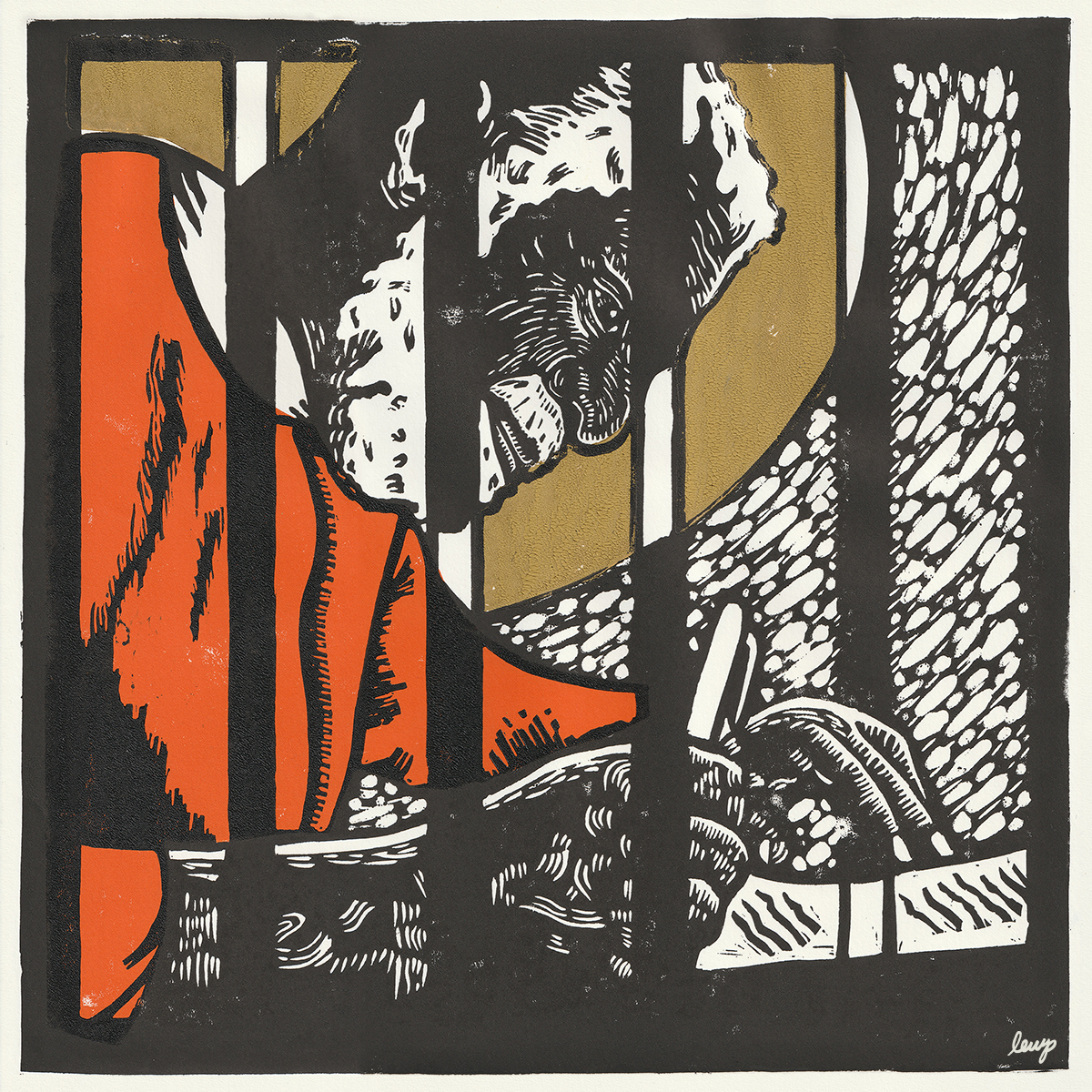
In our reading from the apostle Paul’s second letter to Timothy, Paul spells out exactly what he needs. He is writing from prison near the end of his life. He has practical needs – books, a cloak, his papers. And spiritual and emotional needs. He wants to see Timothy again. He is missing companions and helpers, so he asks Timothy to bring Mark with him. Ever the teacher, Paul has information to pass on, guidance and instructions. Maybe Paul also needs to feel needed.

In our other reading, Job’s situation is much more complicated and yet, at the same time, simpler. Job has just lost all of his children, and all of his livestock. He was one of the wealthiest men in the land and now he has nothing. He was blessed with a large family and now he has none. He was in good health, and now his body is covered with sores. His friends find him outside of town sitting on the ash heap, the spot where everyone dumped their trash and burned it. Job’s life has become trash.
As soon as his friends see Job’s pitiful state, they tear their clothes, a sign of mourning and compassion. And then they do the most beautiful thing – they sit with him in silence for seven days. It’s called “sitting shiva” (shiva means seven). “No one said a word to Job, for they saw that his suffering was too great for words.” (Job 2:13)
When we find someone in trouble, our instinct is often to try to fix things, to make things better, but there’s nothing we can do to fix death. Job’s friends cannot bring back his family, or his livestock, or his health. Words have little meaning at this point, because Job’s anguish is too deep. But the friends can keep Job from having to go through this alone. So they sit with him. And, as the tradition goes, nobody talks until Job is ready to talk.

There was a woman pastor who loved people and would stop and talk to anyone she met. One day she went on a driving trip with the college president who was known for her deep thoughts and limited words. As they rode along, the pastor tried in vain to engage the college president in conversation, so she was silent for many miles. Finally she could stand it no longer, so she turned to her friend and said, “Do you know that we’ve been riding together for almost fifty miles and haven’t said a word?” Without turning her head or taking her eyes off the road, the college president answered, “Good friends don’t need to talk.” They finished the drive in silence.[5]
Never underestimate the value of just being there for someone.
Figuring out how to ask or answer the question, “What do you need?” is easier you have some context. This video talks more of that. The speaker is Rev. Remington Johnson, an ICU nurse in Texas, as well as a PCUSA pastor, hospice chaplain, think tank director, and activist.
VIDEO What Do You Need? Rev. Remington Johnson – 4:47 (© a sanctified art | sanctifiedart.org)
What do you need?

Martin Luther King Jr., answers that question in his sermon entitled, “Paul’s Letter to American Christians.” His explanation for how he came to have this letter reflects his sense of humor. He said it was…
“. . . an imaginary letter which comes from the pen of the Apostle Paul, and the postmark reveals that it comes from the island of Crete. . . written in ill-formed, sprawling Greek. . . For many weeks now I have been laboring with the translation. . . but now I believe I have deciphered its true meaning. And if in presenting the letter the contents sound strangely Kingian instead of Paulinian, attribute it to my lack of complete objectivity rather than Paul’s lack of clarity. It is miraculous indeed that the Apostle Paul should be writing a letter to you and to me nearly nineteen hundred years after his last letter appeared in the New Testament. How this is possible is something of an enigma wrapped in mystery.”
Here’s what he says is needed:
- To bring our moral advances up to speed with our tremendous scientific advances.
- To “never allow the transitory, evanescent demands of man-made institutions to take precedence over the eternal demands of the Almighty God.”
- “To bridge the gulf between abject poverty and superfluous wealth.”
- To see that “God is bigger than all of our denominations.”
- “To get rid of every aspect of segregation.”
He says, “They tell me that one-tenth of one percent of the population controls more than forty percent of the wealth. Oh, America, how often have you taken necessities from the masses to give luxuries to the classes?”
That was in 1960. The percentages are not too different today.[6] Income inequality continues to be an issue, and some say this is the one of the defining issues of our times.
King was quite adamant about our need to solve this. He said, “You can work within the framework of democracy to bring about a better distribution of wealth. You can use your powerful resources to wipe poverty from the face of the earth. God never intended for a group of people to live in superfluous, inordinate wealth while others live in abject, deadening poverty. God intends for all of His children to have the basic necessities of life, and He has left in this universe enough and to spare for that purpose. So I call upon you to bridge the gulf between abject poverty and superfluous wealth.”
King says that God has provided enough for everyone. But so many people struggle to survive. Can it really be true that there’s enough for everyone?

I googled that, of course, and found out that the world produces 1.5 times more food than we need to feed everyone on the planet. The reasons we still have people starving are varied and complicated. War and other disturbances get in the way. Not all of what is grown is used to feed people. Our systems and strategies need work.
When someone is dealing with food insecurity, the answers to the question “What do you need?” can be complicated. Ryan Corwin made a documentary about that.[7] Ryan?
What do you need? Samantha? Anyone else?
What do we need?
The priest and writer Henri Nouwen says that we all have a deep, strong need for unity. But unity can be somewhat elusive because it is a divine gift. Jesus prays for unity among his disciples and among those who through the teaching of his disciples will come to believe in him. He says: “May they all be one, just as, Father, you are in me and I in you . . .” (John 17:21).
Nouwen says we run into trouble when we try to make unity by focusing on each other. When that fails, we become disillusioned, which can make us bitter, cynical, demanding, and even violent. “Jesus calls us to seek our unity in and through him. When we direct our inner attention not first of all to each other, but to God to whom we belong, then we will discover that in God we also belong to each other.”[8]
May God who binds us together give us the wisdom and strength to show up for one another in whatever ways we can.
Let us now seek God together in prayer, but first in a time of silence.
[1] https://www.rd.com/list/short-jokes/
[2] “Paul in Prison,” by Rev. Lauren Wright Pittman, © a sanctified art | sanctifiedart.org
[3] “Break Open,” by Rev. Lisle Gwynn Garrity, © a sanctified art | sanctifiedart.org
[4] Photo by Samuele Errico Piccarini on Unsplash
[5] Adapted from David L. McKenna, The Communicator’s Commentary: Job (Waco: Word Publishing, 1986), pg. 48-49.
[6] “Federal Reserve data indicates that as of Q4 2021, the top 1% of households in the United States held 32.3% of the country’s wealth, while the bottom 50% held 2.6%.” https://en.wikipedia.org/wiki/Wealth_inequality_in_the_United_States#:~:text=The%20accumulation%20of%20wealth%20enables,bottom%2050%25%20held%202.6%25.
[7] https://www.youtube.com/watch?v=1pVBhaNfi4U
[8] 7/28/23, 11:30 AM Gmail – Nouwen Meditation: The Divine Gift of Unity https://mail.google.com/mail/u/0/?ik=a0473c291e&view=pt&search=all&permthid=thread-f:1772654313241794573&simpl=msg-f:1772654313241794573

 United Presbyterian Church