


Watch on YouTube
[1] How many of you leave your porch light on all night? Why do you do that?
How many of you only leave your porch light on if you’re expecting someone to come to your house?
What would you do if you arrived at a house and there were no lights on out front? Would you feel welcome? (On Halloween we skip houses that are dark.)

Before electricity, people didn’t have porch lights, so instead they would put a candle in the window to help people find their house. And if a family member was away on a trip, they would keep the candle burning in the window until they got home.
There were no streetlights, so the light in the window helped travelers to find their way. The candle in the window also sent the message that the traveling family member was remembered. The burning candle was a sign that the person was loved, missed, and held in the family’s thoughts and prayers during their absence.[3]
Who are we missing that needs to know they are loved, missed, held in our thoughts and prayers, and welcome?
If the apostle Paul had a home, I would imagine he would keep a candle burning in the window all the time to welcome anyone who needed a place to rest, and to welcome anyone who might be willing to hear the good news about Jesus the Messiah, and God’s love and grace. Paul was eager to tell anyone and everyone about the love of God in Christ that had changed his life.
Paul desperately wanted Jews and Gentiles alike to know that Jesus taught a new way of being in relationship with God, not by strict obedience to the law, but by grace through faith in Jesus Christ. Paul compares grace with the law: For Moses writes that the law’s way of making a person right with God requires obedience to all of its commands. (Romans 10:5) But Moses had also reminded them that Moses also had said that God had rescued Israel out of Egypt and brought them to the promised land, not because they were better than other nations, but because God loved them and had promised their ancestors. (Deut 7:7-8, Deut 9:4-5)
Moses had encouraged Israel to be obedient to God’s law so that they would remain in God’s good grace. But no one can be good enough. So Jesus simplified by summarizing it in two commands: Love the Lord your God with all your heart, soul, mind and strength, and love your neighbor as yourself. His law is love.
Paul wanted EVERYONE to know about God’s unlimited generosity and unconditional love, and that EVERYONE who calls on the name of the Lord will be saved. (Romans 10:13)
But how would they know if no one told them?
In Paul’s time, the main way news got around was by word of mouth. If nobody told about Jesus, they wouldn’t know. Today, if you ask people whether they’ve heard of Jesus, odds are they will at least know basically who he is. But beyond that probably depends on whether their parents took them to church, or what kind of experiences they’ve had with people who profess to be Christians. Did they hear a message of love? Or a message of rules to follow?
- Do you remember the first time you heard about Jesus? Who told you?
- Do you remember the first time you came to church? Who brought you?
- How did you know where to go and what to do?
Many of us may not be able to answer those questions because it was too long ago, or we were too young to remember. We’ve forgotten or maybe never experienced the challenge of going to a church for the first time.
When I was in seminary I got asked to fill in for vacationing preachers fairly often, so it seemed like every Sunday I was at a church that was new to me.
Can you guess what the first problem was at many of those churches? (Where to park.)
Can you guess what the second problem was? (What door to go in.)
- At one church, I went in what seemed like the most obvious door and walked in on a Sunday school class in session. Awkward.
- At another church, I went in what looked like the front door and found myself on a stairway landing. So then I had to guess whether to go up or go down.
These were churches that knew I was coming, and that I’d never been there before. I knew that I needed to be there to preach, so I had to keep going despite the uncertainty. Imagine someone who isn’t sure about going to church at all, and then has to figure out where to park, what door to use. They might just give up.
Have you ever walked into a building that only had a few of the lights turned on? Did you wonder whether you were in the right place?
Having well-lit environments is high on the list of how to make a place more welcoming.
Another important part of being welcoming is to greet people with a smile. Do you smile here? Are you happy to be here? What makes you happy to be here? (Seeing friends?)
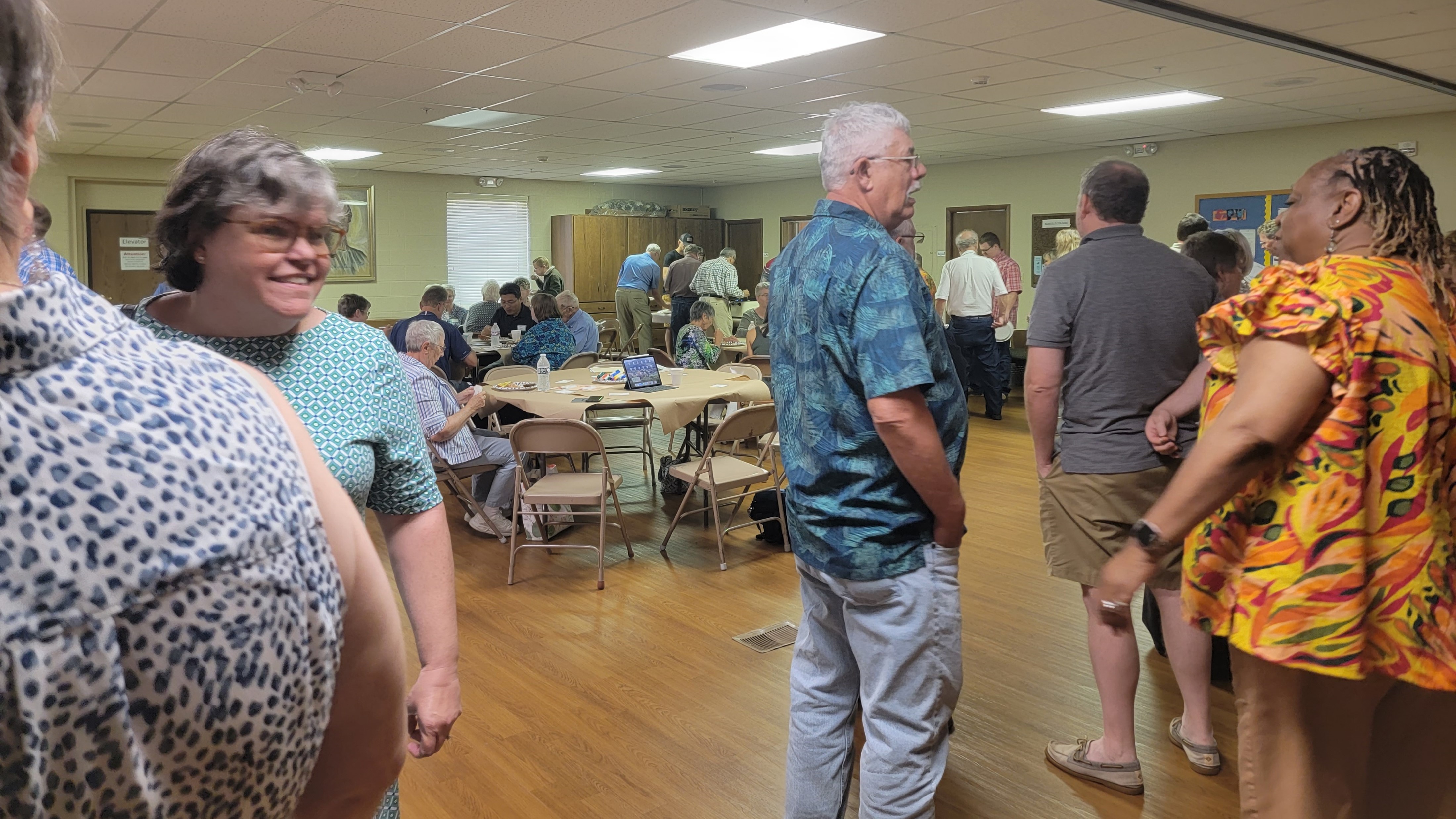
Smiling is a big part of making people feel welcome. So is using their names. Take a moment and look around the room. Then raise your hand if you know the name of every single person here.

Yesterday we hosted our presbytery here. We had about 70 people from all across southern Kansas. We had a BBQ lunch (thank you to all of you who brought food!) and we had our entire meeting in the fellowship hall so that we could engage one another. We had some great conversations.
At presbytery meetings we always have to sign in – so we had tables set up in the entry way,
and at one of them we got name tags.
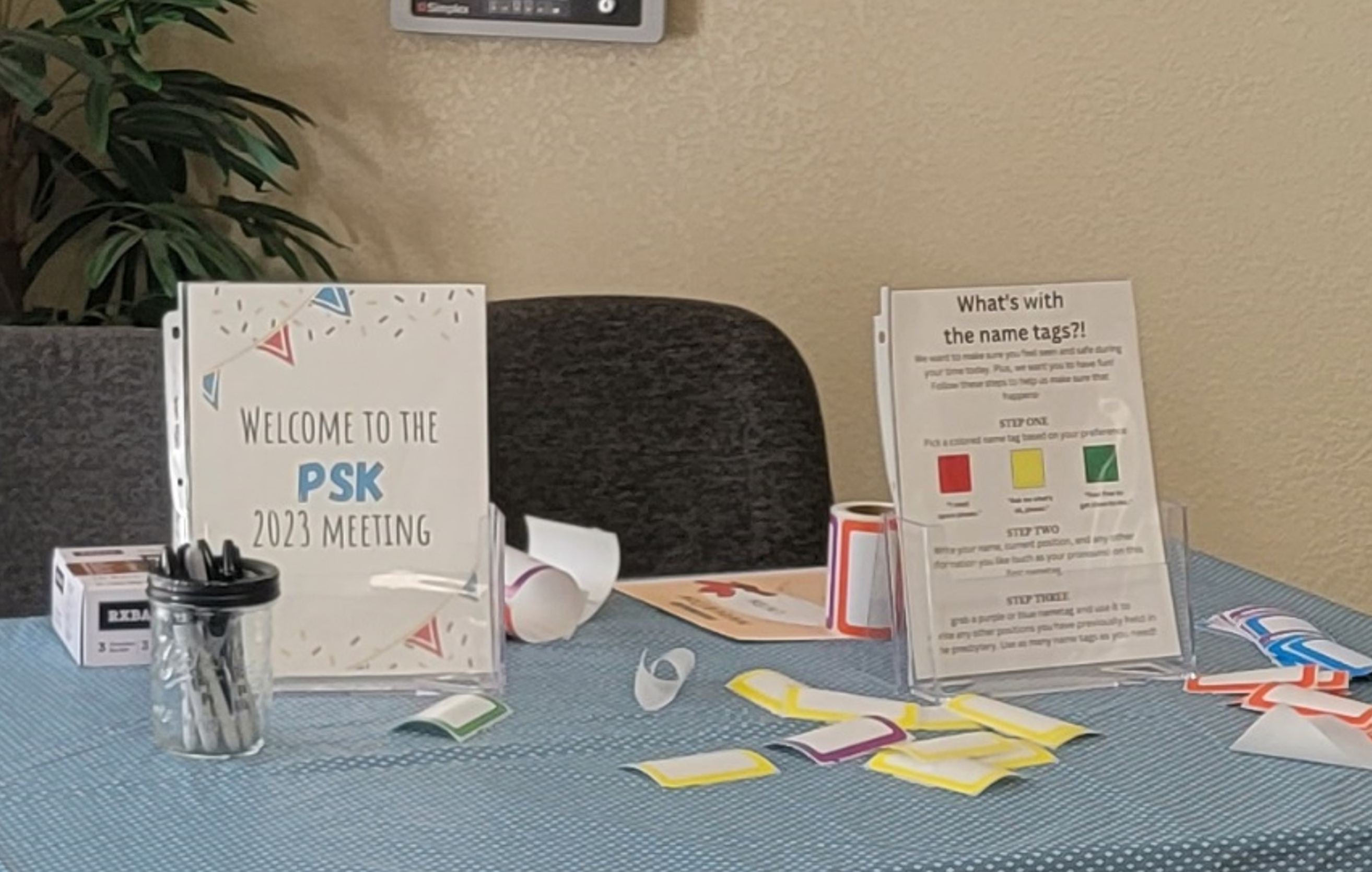
Yesterday’s name tags were extra communicative. I loved them so much that I brought some to show you. One of my favorite ideas here was that they were color-coded to your comfort level with being close to people. Green means “feel free to get close to me; yellow means “ask me what’s ok please”; and red means “I need space please.” What color would you choose? Can you guess what color I chose?
There were lots of smiles, and everybody got to know our names, and got to know what level of interaction would be best.
Those are some pretty simple ways to make people feel welcome here at church, in our homes, or business. Some of you have been preparing to welcome students to school. What are you doing to make them feel welcome? Students, notice how the teachers and staff work to make you feel welcome. Will you help them out? Welcome your friends? Welcome new teachers and staff?
Why does it matter whether people feel welcome? Because the good news of God’s love is for everyone, and the more we make people feel welcome, the more we’ll have opportunities to show and tell them about God’s love. And help them know they are loved, missed, held in our thoughts and prayers, and welcome.
Really, the bottom line is to love one another so that everyone know they don’t need to do life alone. Maya Angelou talks about this in her poem entitled Alone:
Lying, thinking
Last night
How to find my soul a home
Where water is not thirsty
And bread loaf is not stone
I came up with one thing
And I don’t believe I’m wrong
That nobody,
But nobody
Can make it out here alone.
Alone, all alone
Nobody, but nobody
Can make it out here alone.
There are some millionaires
With money they can’t use
Their wives run round like banshees
Their children sing the blues
They’ve got expensive doctors
To cure their hearts of stone.
But nobody
No, nobody
Can make it out here alone.
Alone, all alone
Nobody, but nobody
Can make it out here alone.
Now if you listen closely
I’ll tell you what I know
Storm clouds are gathering
The wind is gonna blow
The race of man is suffering
And I can hear the moan,
‘Cause nobody,
But nobody
Can make it out here alone.
Alone, all alone
Nobody, but nobody
Can make it out here alone.[4]
Would you agree? Who has helped keep you from having to make it out here alone?
Let’s take a few moments to think about the people in our lives. Who has loved you into being the person you are?[5]
Where and when did you spend time with them?
Where and when do you spend time with people now?
There was a church that had spent quite a bit of time and effort decorating their Sunday school rooms with beautiful murals, but whenever kids were there, they couldn’t get them to settle down, except in one room. In the storytelling room, they had giant pillows all over the floor. Kids would instantly plop down on the pillows, ready to listen to a story. But the other rooms didn’t have pillows, or chairs. Kids can sit on the floor, but it’s harder to get them to settle in when it’s uncomfortable.
Another church wanted to make their facility more welcoming. While they were working on figuring out how to do that, one of the members who owned a landscaping business asked if he could work on the church’s landscaping. He took out all the old, overgrown bushes, put in new plants, and added some seating areas for people to sit and talk. Long before the church did anything to upgrade the facility, they already had new people coming because they noticed the new landscaping that made the church look more alive and welcoming.
In a way, the landscaping was like leaving a candle burning in the window. It helped people to know they were loved, missed, held in our thoughts and prayers, and welcome, even before the church knew who they were.
Who do you know that needs some encouragement? Who needs to know they are loved, missed, held in our thoughts and prayers, and welcome?
How can we let them know?
Is this a place where we feel welcome? Let’s share that welcoming spirit so that everyone can know that God’s love and grace is for us all.
[1] Photo by Greg Rosenke on Unsplash
[2] Photo by Sixteen Miles Out on Unsplash
[3] https://www.lovetoknow.com/home/design-decor/candle-window-traditions-their-hidden-meanings#:~:text=What%20Does%20It%20Mean%20to,for%20their%20loved%20one’s%20return.
[4] From Oh Pray My Wings Are Gonna Fit Me Well By Maya Angelou. Copyright © 1975 by Maya Angelou. Reprinted with permission of Random House, Inc. on https://poets.org/poem/alone
[5] https://www.americanrhetoric.com/speeches/fredrogerslifetimeachievementemmyaward.htm

 United Presbyterian Church