


Watch on YouTube
If we were to design our own deity, our own god, what would we want that god to be like?
I would want my god to be accessible and comforting and maybe huggable…like this frog.

Did you know that there are companies that will take your drawing and make it into a plushie, a stuffed animal?
This picture is from one of those company websites. I particularly like this one because it reminds me of a Mercer Mayer character. It’s fun to see a two-dimensional drawing come to life as a three-dimensional doll, taking something that was in a child’s imagination and instead of dismissing it as silly or impossible, it now exists.
What would you draw?

In our story today, instead of a drawing of God, the priest Aaron makes a statue. The people of Israel were impatient about waiting for Moses to come down off of Mount Sinai where Moses was meeting with God. So they asked Aaron to make them a new god. He collects everybody’s gold earrings and he melts those down and makes a calf. Some versions say a bull calf.
UnBullievable.
I’m sure a gold statue is beautiful and awe-inspiring, but it’s not very huggable, and it’s also heavy, so it’s going to be a bear to carry around. But it makes the people happy, and they have quite a party celebrating their new god.
Why did this happen? There are lots of theories. The bull was a common image in Canaanite religions. Old Testament scholar Wil Gaffney points out that “in the old written language before the more familiar Hebrew letters, the first sign in the word God was an image of a bull.”[3]
Maybe the people felt like they had lost their only tangible connection to God when Moses took so long to come back.
I think we have to remember that they’ve spent their whole lives being held captive in a foreign country, forced to do hard labor. The Pharaoh had tried to keep them subdued by killing their babies and limiting their access to food and water. When they do finally escape, Pharaoh’s army chases after them. They miraculously make it out, crossing the Red Sea, and now they’re in the desert, and the person who led them there has been up on a mountain for 40 days. Is he coming back? Is he dead or alive?
We can imagine what they might be thinking. What are we gonna do now?
How do you know what to do when all your life all you could do was what your captors told you to do?
Maybe they were just impatient and bored. They’d never had this much time to do nothing.
Some rabbinic commentators say that this episode in Israel’s history is their lowest point and their most disgraceful act.[4] But I think the Israelites deserve more grace than that. After all, Moses had said they were coming out to the desert to worship. How do they know how to worship now? They really don’t yet. Some say that this incident is what led to the directions for worship in the book of Leviticus.[5]
This is happening in the desert at the foot of Mount Sinai. It’s only been a few months since they escaped from slavery in Egypt, and they have only recently been told about God making a covenant with them. God’s instructions include the Ten Commandments, which are quite old news to us, but to them, they were brand new.
And now they have broken the first two.
In stating these ten rules, God begins with a reminder of what God has done already for these people:
2 “I am the Lord your God, who rescued you from the land of Egypt, the place of your slavery.” (Exodus 20:2)
God says, “That amazing escape you just made from that horrible country that enslaved you for 400 years? That was me.”
And now that you’ve been rescued, let’s talk about how this is going to work. First,
3 “You must not have any other god but me.
The people probably thought that sounded pretty easy. The Egyptians had several gods. Having just one certainly simplifies things. Next?
4 “You must not make for yourself an idol of any kind or an image of anything in the heavens or on the earth or in the sea.
Ok.
But wait, there’s more about that….
5 You must not bow down to them or worship them, for I, the Lord your God, am a jealous God who will not tolerate your affection for any other gods. I lay the sins of the parents upon their children; the entire family is affected—even children in the third and fourth generations of those who reject me.
This is sounding pretty serious now.
God’s conversation with Moses in today’s reading shows us how serious it is. God tells Moses to get out of the way so God’s fierce anger can blaze against them. We say they’d been warned in the second commandment:
I, the Lord your God, am a jealous God who will not tolerate your affection for any other gods.
God says, “Step away from the Jews, Moses, so I can smite these people.”
This is most definitely not the loving, cuddly God I wanted. This is the picture of God that religious leaders like to use to scare people into submission. This is the picture of God that gets used by church leaders who are abusing their power and exploiting people’s fear.
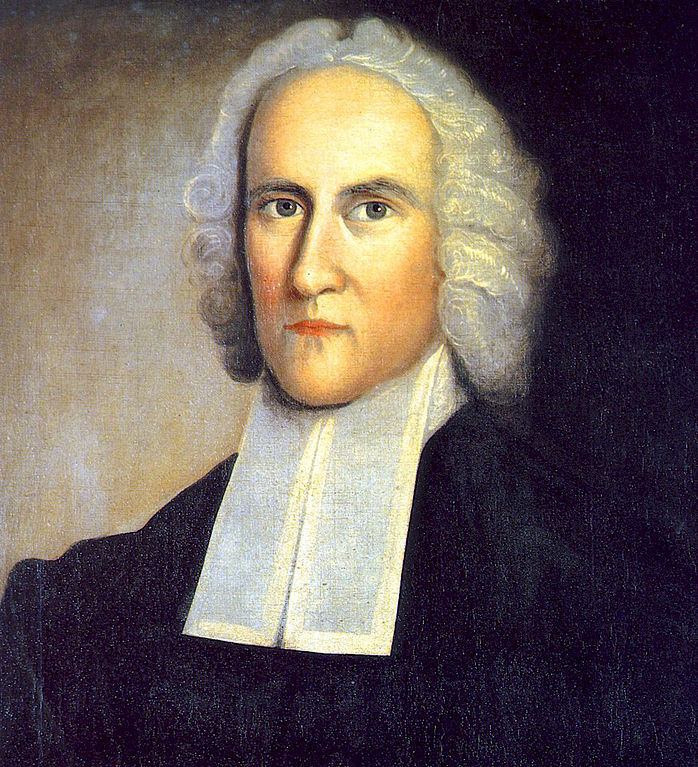
One of the most famous examples is the sermon preached in 1741 by Puritan minister Rev. Jonathan Edwards entitled, “Sinners in the Hands of an Angry God” in which he emphasized God’s righteous anger at sin and desire for people to repent. Edwards is a part of the time in American History called the Great Awakening when revivals were popular and religious enthusiasm was growing. He’s credited with influencing the birth of American Evangelicalism and helping spark the American Revolution. To be fair, though the sermon about the angry God is his most famous, he also talked about God’s love and “the free, eternal, distinguishing love and infinite grace of Christ.”[7]
And we see that love in the last part of the second commandment:
6 But I lavish unfailing love for a thousand generations on those who love me and obey my commands.
Ah, there’s the good news. God’s unfailing love that goes on forever.
Unfortunately too many have used the image of an angry God in harmful, even abusive ways:
- If someone told you that you weren’t worthy of God’s love, that was an abuse of church power.
- If someone told your secrets to others and called it prayer, that was an abuse of church power.
- If a woman is told that her abusive husband’s behavior was her fault, that was an abuse of church power.
- If someone said that depression was evidence that we lacked faith, that was an abuse of church power.[8]
If you have experienced this kind of abuse, I’m so sorry that happened.
We should note that although God gets angry in this story in Exodus, the only person who knows about it is Moses. Moses argues with God about it, stands up for the people he has been called to lead, and then God does NOT destroy the people.
The last verse we read today tells us that God changed his mind. God relents.
To me, those two words are the most important part of this story. God relents. God DOES change his mind.
What does NOT change is the essential nature of God.
- God loves justice, mercy, and humility. (Micah 6:8)
- God stands against the proud, and for the humble (James 4:6)
- God is love (1 John 4:7)[9]
Rev. Miguel De La Torre, a professor at Iliff School of Theology in Denver, sees today’s text as an example of taking the call to be God’s chosen people as meaning that they are better than other people, what De La Torre calls exceptionalism. Exceptionalism claims to be ordained by God but in reality is egos on fire, and greed for money and power.
He says “Here is the question the people of God must answer if they are to claim chosenness: is our church standing with the oppressed, or justifying the actions of the oppressors? …Our quest for the golden idols of power and privilege has made all who think they are chosen for riches enemies of God. As the psalmist reminds us, “They exchanged the glory of God for the image of an ox that eats grass” (Ps. 106: 20). We are a stiff-necked people …”[10]
This is God’s complaint to Moses. “I have seen this people, how stiff-necked they are.” (Ex. 32:9)
Stiff-necked means stubborn and proud, unwilling to humble themselves or bow their heads.
What gets us in trouble is our stubbornness and pride, our impatience, and our tendency to hold on to idols of our own making. We have made idols out of rules and systems and institutions. We have made idols out of comfort and privilege.
Often in the Bible, our relationship with God is described as a marriage. God’s covenant relationship with us is not a business contract, but a relationship of commitment to love one another above all else. God’s anger and jealousy flares in today’s story to help us to understand how deeply God loves us. It’s an example of anthropomorphism, using human characteristics to describe God and to help us to understand God. It’s what Calvin calls accommodation – using concepts we can understand to help us relate to God who is essentially beyond our understanding.
The comparison to marriage helps us to see that, just like a marriage, our call is to be faithful to God, to love and trust God more than anything or anyone else. To spend time with God, like we spend time with people who are important to us.
In what ways do we give our ultimate loyalty and allegiance to something or someone other than God?[11]
There are a million ways we might be answering that. Sometimes, what helps us see who or what we’re trusting more than God, is that that who or what lets us down or gets removed from our lives. If our lives have been too much built around a particular job, or our standing in the community, or a special person, and we lose those jobs or standing or persons who have been our gods, we are devastated. We are left wandering in the wilderness, unsure how to proceed.
The people in today’s story are no longer slaves in Egypt. They’re becoming something new. They’re on a journey through the wilderness with God that ultimately becomes something much greater than they could ever imagine. That journey continues today with us. In many ways, we’re in a new wilderness as we struggle to let go of old ways and let God lead us into new ways of being God’s people, loving God and our neighbors, and following Jesus.
Just like the people in the desert in today’s story, we will make mistakes. And just like God did with them, God does with us.
God relents. God has compassion. God is gracious and merciful and forgiving.
And He loves us so much that we have what those people didn’t have, a tangible reminder of God’s great love and compassion in the person and teaching of Jesus.
Thanks, God.
Cover photo Adoration of the Golden Calf — Nicolas Poussin, National Gallery, London, UK
[1] https://makemyplush.com/products/convert-childrens-drawing-into-custom-plush
[2] Photo by Kevin Luke on Unsplash
[3] https://www.wilgafney.com/2017/10/15/the-bull-in-the-church-isnt-idolatry/
[4] https://www.chabad.org/library/article_cdo/aid/3613047/jewish/What-Was-the-Golden-Calf.htm
[5] https://www.christiancentury.org/article/interview/golden-calf-and-consuming-fire
[6] Portrait of Jonathan Edwards by Joseph Badger (1708–65). (Licensed under Public Domain via Wikimedia Commons.) accessed at https://www.loa.org/writers/178-jonathan-edwards/
[7] https://www.christianitytoday.com/history/2018/may/jonathan-edwards-more-than-sinners-in-hands-of-angry-god.html
[8] Cook, Alison. https://www.dralisoncook.com/church-hurt-4-steps-healing/
[9] Cook, Ibid
[10] MIGUEL A. DE LA TORRE in Joel B. Green, Thomas G. Long, Luke A. Powery, Cynthia L. Rigby, Carolyn J. Sharp. Connections: A Lectionary Commentary for Preaching and Worship (pp. 834-835). Presbyterian Publishing Corporation. Kindle Edition.
[11] Marcus Borg, The Heart of Christianity, pg. 33

 United Presbyterian Church