

Watch on YouTube

A man in a movie theater noticed what looked like a goat sitting next to him.
“Are you a goat?” asked the man.
“Yes.” replied the goat.
“What are you doing at the movies?”
The goat replied, “Well, I really enjoyed the book.”[1]
It’s kind of a silly question to ask: “Are you a goat?” Wouldn’t it be obvious? But then, not everything is.
I need to tell you that there was a time when I very much disliked this parable about the sheep and the goats. I couldn’t see how Jesus could be telling people that they had to do certain things to have eternal life, when elsewhere the Bible is so clear that we can’t earn grace, and Jesus himself illustrates this beautifully in the parable of the lost son (Luke 15:11-32). But I didn’t even want to wrestle with this seeming conflict back then, so I just ignored this parable. Maybe some of you have wrestled with this parable too.
But I was missing the point, much in the same way that Jesus told the Jewish leaders that they were missing the point, just as the Old Testament prophets had been telling Israel for centuries that they were missing the point. I was focused primarily on doing the “right” things:
- Going to church faithfully,
- Reading the Bible,
- Having a prayer time,
- Loving God with all my heart, soul, mind, and strength.
But I wasn’t nearly as focused on loving my neighbor or paying attention to the least of these, the overlooked and ignored.
It is not hard to find passages that parallel what Jesus says in Matthew 25. For example, Isaiah 1:11-13,16-17:
What to me is the multitude of your sacrifices? says the Lord;
I have had enough of burnt offerings of rams and the fat of fed beasts;
I do not delight in the blood of bulls or of lambs or of goats.
12 When you come to appear before me,who asked this from your hand?
Trample my courts no more!(K)
13 Bringing offerings is futile; incense is an abomination to me.
New moon and Sabbath and calling of convocation—
I cannot endure solemn assemblies with iniquity.
16 Wash yourselves; make yourselves clean;
remove your evil deeds from before my eyes;
cease to do evil;(O)
17 learn to do good;
seek justice;
rescue the oppressed;
defend the orphan;
plead for the widow.(
Hosea sums this all up in one verse:
Hosea 6:6: For I desire steadfast love and not sacrifice,
the knowledge of God rather than burnt offerings.
Love and the knowledge of God. In other words, salvation is by grace through faith in Jesus Christ, but loving relationships matter more to God than deeds done without love, as the Apostle Paul eloquently explains in 1 Corinthians 13:1-3:
If I speak in the tongues of humans and of angels but do not have love, I am a noisy gong or a clanging cymbal. 2 And if I have prophetic powers and understand all mysteries and all knowledge and if I have all faith so as to remove mountains but do not have love, I am nothing. 3 If I give away all my possessions and if I hand over my body so that I may boast[a] but do not have love, I gain nothing.
I could go on quoting verses, but honestly I think I’m just proving to myself that I was missing the mark before. Maybe that’s why this parable annoyed me so much. It was showing me something I needed to work on and I didn’t want to see it.

My perspective has gradually changed over time, and even more since we decided to be a Matthew 25 church and started learning more about structural racism and systemic poverty.
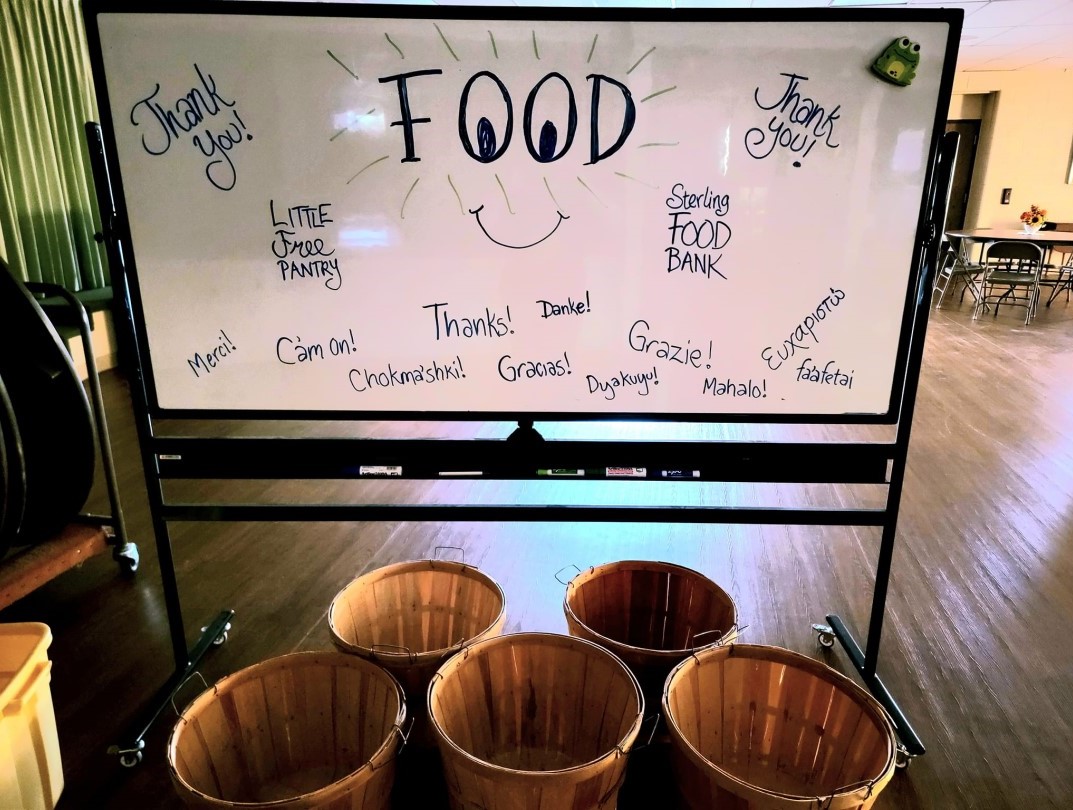
There are so many ways to live out our Matthew 25 commitment, and the more we learn, the more we find to work on. Feeding people is definitely part of it. Some great examples include the community Thanksgiving dinner that the Sterling community has been doing for so many years, and the Sterling Food bank. As we learned more about the challenges facing people in need, we put up our little free pantry. Thank you all so much for all the ways you help support ministries of feeding, and for bringing food today.
Maybe the most daunting aspect of our Matthew 25 commitment is that it calls us to go beyond treating the symptoms of poverty and work to help eliminate the causes. Not just poverty, but systemic poverty.
Systemic poverty is the economic exploitation of people who are poor through laws, policies, practices and systems that perpetuate their impoverished status.[2] This includes how we talk about people in need, and how we vote. In our culture, we have a strong tendency to blame the victims of poverty and other tragedies. We assume that people did something to cause their trouble. This in turn causes us to make laws that do more harm by perpetuating their trouble.
But in fact, poverty and other social miseries are in large part due to social structure, Some societal issues, such as racism, sexism and segregation, constantly cause disparities in education, employment and income for marginalized groups.[3]
Poverty is, in many cases, not a lifelong situation. A 50-year longitudinal study of 18,000 Americans, has shown that around four in 10 adults experience an entire year of poverty from the ages of 25 to 60. Which means one in four of the people in this room and watching online has experienced poverty at some point.
War and violence contribute hugely to homelessness and hunger. Last Sunday, Dr. Glenn Butner talked about Matthew 25:35 in which Jesus says, “I was a stranger and you welcomed me,” as part of his update about welcoming Ukrainian refugees. The work that the Rice County community is doing to welcome two refugee families, and soon a third family, is a great way to live out this verse, but a stranger isn’t just someone from outside the United States. The language in the Message version that we read today points this out.
“Whenever you did one of these things to someone overlooked or ignored, that was me—you did it to me.” (Matthew 25:40)
Who are the overlooked and ignored?
Our denomination’s mission agency last year expanded the Matthew 25 movement to include three priorities that intersect with poverty and racism: climate change, militarism, and gender justice/heteropatriarchy. This broadens the scope but also recognizes that all of these issues impact each other.
Welcoming people is maybe the deepest and hardest part of ways we live out Matthew 25. We can provide food and clothing from a distance. Often we never meet the recipients of our offerings. When we go to visit someone we control the visit and choose whether we only stay for a few minutes or long enough to have a more involved conversation. Welcoming someone into our home or our church is a much more vulnerable act of giving. Even inviting someone to a restaurant with you is a statement of welcoming – a public gesture of acceptance and friendship.

In Luke 14 we read that Jesus said to the man who had invited him, “When you give a dinner or a banquet, do not invite your friends or your brothers or your relatives or rich neighbors, lest they also invite you in return and you be repaid. But when you give a feast, invite the poor, the crippled, the lame, the blind, and you will be blessed, because they cannot repay you. For you will be repaid at the resurrection of the just.” (Luke 14:12-14)
There was a story in Our Daily Bread this week about a woman named Wanda who “sent a text inviting her grandson to Thanksgiving dinner, not knowing he’d recently changed his phone number. The text instead went to a stranger, Jamal. Jamal didn’t have plans, and so, after clarifying who he was, asked if he could still come to dinner. Wanda said, ‘Of course you can.’ Jamal joined the family dinner in what has since become a yearly tradition for him. A mistaken invitation became an annual blessing.”[5]
Welcoming the left out can be subtle, but the subtleties matter. There was a young man named Eric who realized he was gay in middle school and by the time he’d graduated high school he’d talked about it with his friends and family and was able to be fully himself everywhere he went…except church. Eric’s family was quite involved at church, attending regularly, but since he had to dress and act differently at church to hide his true self, he didn’t go very often. Their church practiced adult baptism and when everyone in his family had been baptized except him, his mom kept pressuring him until finally he agreed to go to the baptism class. After the class, the pastor approached him. “Eric, you seem troubled. What is bothering you?” Eric tells the pastor that he’s hesitant to be baptized because he feels that in church, he has “to hide parts of [himself] that others might not be comfortable with.”[6] Finally he’s going to be able to trust his church enough to be himself…we hoped as we watched…but instead the pastor’s response says the opposite. The pastor says, “That’s a private matter between you and God. Nobody else needs to know what’s between you and God.” Ugh. In other words, just keep hiding and you can still be here.
There’s an old adage that says silence in golden, but in reality silence is a great way to make people feel unwelcome. Prejudice, fear, and hate often hide in the silence. God knows what’s in our hearts and minds, but the only way for our neighbors to know whether they are loved or hated is to tell them, and to welcome them.
You’ve probably heard someone say, “God doesn’t make junk.” It’s true. Psalm 139 says that we are God’s masterpieces, wonderfully made. But what if people are also telling you that you can’t be the way you were made?
Writer and online pastor Austen Hartke wrestled with this. He tells how as a teenager he “believed strongly in the idea that everything happens for a reason, and if that was true, then there must have been a reason God had made [him] with [the] body” he has. He says, “the biggest hurdle I faced in addressing my gender identity was that it seemed like saying God was wrong.” But the more Austen studied scripture, the more he was able to say no to the question, “Did God make a mistake?”[7]

Writer and Christian Educator Jamie Bruehoff says, “Our daughter Rebekah shows us what is possible when a transgender young person is surrounded by love, affirmation, and celebration…The first time Rebekah showed up at church as herself, one parishioner found my husband afterward and said, ‘I don’t really understand this whole transgender thing. But she used to hide behind you and refuse to say ‘Hi’ to me on Sunday mornings. Today, she ran up to me, twirled in her dress, and gave me a high five. What more is there to know?’”[9]
How beautiful it is when we can love and welcome one another just as God loves and welcomes us. And the e good news is that God knows us and knows what we think and say and do, and how we love our neighbors, even if no one else does, and that the more we seek to love God and love one another, the Holy Spirit pours God’s love into our hearts to help us to love one another and help one another more.
Thanks, God.
[1] (From http://www.kccathedral.org/2011_pentecostlast_christtheking/)
[2] https://www.presbyterianmission.org/ministries/matthew-25/poverty/#:~:text=Systemic%20poverty%20refers%20to%20the,that%20perpetuate%20their%20impoverished%20status.
[3] https://ihpi.umich.edu/news/why-poverty-not-personal-choice-reflection-society#:~:text=In%20fact%2C%20poverty%20and%20other,functions%20at%20a%20macro%20level.
[4] Photo by Valiant Made on Unsplash
[5] Lisa Samra, Our Daily Bread, https://odb.org/2023/11/23/unexpected-blessing-2
[6] As quoted at https://www.teenvogue.com/story/eric-sex-education-season-4-queer-people-god-op-ed
[7] Hartke, Austen (2023-03-20T23:58:59.000). Transforming: Updated and Expanded Edition with Study Guide: The Bible and the Lives of Transgender Christians. Presbyterian Publishing. Kindle Edition.
[8] Photo by takahiro taguchi on Unsplash
[9] Hartke, Austen (2023-03-20T23:58:59.000). Transforming: Updated and Expanded Edition with Study Guide: The Bible and the Lives of Transgender Christians. Presbyterian Publishing. Kindle Edition.

 United Presbyterian Church