


Watch on YouTube
[1] What you see is what you get.
The first time I heard this phrase I was watching Laugh-In on TV in the 1970s with my parents. The comic Flip Wilson was dressed as a woman doing his character Geraldine. She was sassy and straightforward and didn’t take guff from anyone. Her signature response was, “What you see is what you get, honey.” Ironic on several levels, since she was a man, and she was full of double talk. I thought Flip was funny, but Geraldine was brilliant.
Now we are more likely to associate what-you-see-is-what-you-get with computers and the front-end user screen called a graphical user interface (GUI). WYSIWG software started showing up on personal computers in the 1980s, but the idea began in the 1940s when Dr. Vannevar Bush was the director of the office of scientific research and development, a government office that reported directly to then President Roosevelt.[2] Dr. Bush’s office oversaw all sorts of projects, including the Manhattan project. In the movie Oppenheimer Dr. Bush is a background character, but he was a man of vision. In an article published in The Atlantic in 1945, just after the war, he encouraged scientists to take the knowledge gained in their war projects and use it to continue improving our access to knowledge. In doing so, he emphasized the importance of using pictures and graphics and imagined a device of the future that would do all that we now take for granted in our computers and smart phones.[3] He envisioned what we know as GUI or graphical user interface, which is the reason computer screens don’t look like this anymore.

Long before computers and cameras, knowledge and vision was conveyed in drawings and pictograms, and dreams, like the one in Genesis 28 in which Jacob saw “as he slept…a stairway that reached from the earth up to heaven. And he saw the angels of God going up and down the stairway.” (Gen. 28:12)
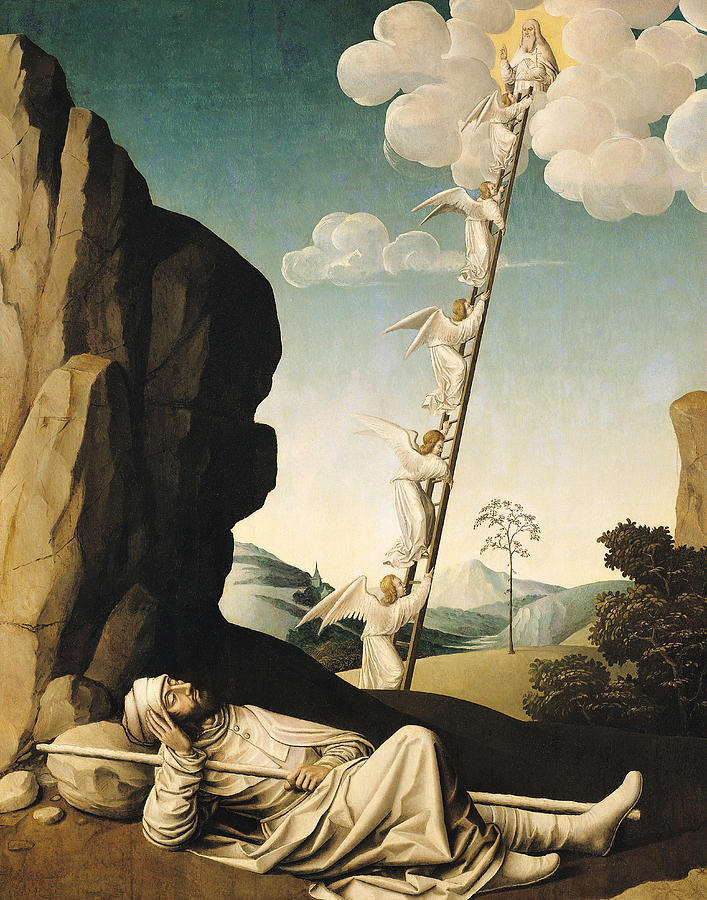
Jacob was given a vision of a future that he wouldn’t live to see, when hundreds or maybe even a thousand years later, Jesus would be that stairway (also known as Jacob’s ladder). This is the allusion Jesus makes at the end of today’s reading when he tells Nathaniel, “Very truly, I tell you, you will see heaven opened and the angels of God ascending and descending upon the Son of Man.” (John 1:51)
In essence, Jesus is saying, “What you see is what you will get as you follow me.” Come see for yourself. The kingdom of God was at hand…IS at hand…and Jesus and the Holy Spirit help us to see it, to see God working in us and in the world around us. They help us to have spiritual sight. Just as WYSIWIG computers came into being through a series of epiphanies and visions of the future, our experience with God and understanding of Jesus grows through epiphanies and visions as God and God’s kingdom is revealed to us in a myriad of ways.
In today’s reading, we jump into the middle of the story of Jesus calling the first disciples. John the Baptist had been preparing the way with his message that the kingdom of God was at hand and the Messiah was near. John saw Jesus and pointed him out to some of his own disciples and they started following Jesus around. They were curious, not surprisingly, and when they started asking Jesus questions, he invited them to come see for themselves. One of those men was Andrew, who then went to find his brother Peter so that he could come and see as well.

Then in today’s scripture, Jesus meets Phillip and invites him to join the group, and then Phillip goes to find his brother Nathaniel. Phillip excitedly tells Nathaniel about his epiphany:
“We have found the very person Moses and the prophets wrote about! His name is Jesus, the son of Joseph from Nazareth.”
Maybe Nathanael isn’t really listening until the last word, because that’s the word he jumps on.
“Nazareth!” exclaimed Nathanael. “Can anything good come from Nazareth?”
Phillip doesn’t argue. He just says, “Come and see for yourself.” (John 1:45-46 NLT)
Then when Jesus sees them approaching, he says, “Now here is a genuine son of Israel—a man of complete integrity.” (John 1:47)
Jesus is basically calling Nathanael a what-you-see-is-what-you-get guy. Some of the translations say, “a man in whom there is no deceit.” It’s another allusion, this time to Jacob himself. Jacob is the one who deceived his father Isaac so he could steal his older brother’s birthright. Jacob’s name means “the deceiver.” But in Nathanael there is no deceit.
Nathanael doesn’t argue with this, but he wants to know how Jesus knows him. Jesus’ answer simple. “I saw you under the fig tree earlier.”
Can you really know someone is a person of integrity just by seeing them?
No, and neither can you know someone just by the town they came from.
Those sorts of snap judgements get us into trouble.
But Jesus is more intuitive than judgmental. He sees with spiritual sight, and apparently Nathanael feels seen. Now that Nathaneil has seen Jesus for himself, he changes from thinking of Jesus as a no-good Nazarian, to exclaiming, “Rabbi, you are the Son of God—the King of Israel!” (John 1:47-49) Nathanael has had an epiphany, a revelation, a God moment.
We are in the season of Epiphany which started on January 6, when we commemorate the Magi finding Jesus by following a star.[7] Our scripture readings for the season of Epiphany tell us about people who have epiphanies, to whom Jesus and the kingdom of God are revealed, as when Andrew and Peter, Phillip and Nathanael see Jesus for themselves.
An epiphany is an “aha” moment, something that changes our perspective or understanding.[8] They can happen more than once, and be deeply profound or small and simple. They allow us to see something we hadn’t seen before, or to see in a new way.
In the inspiration for WYSWYG software back in the 1940’s, Dr. Bush was encouraging scientists to take the knowledge they already had and find new ways to apply it and make it accessible. He has a vision for the future, and in it he sees them working together to create the future.
Unfortunately, working together is hard, and so we tend to stick to doing things on our own. Also, knowledge is power, and we are reticent to share that power. According to tech writer Joe Robinson, that’s why it took forty years before the idea for a graphical user interface or WYSIWYG became a reality. In the movie Oppenheimer, that’s one of the frustrations for the physicists working on the various aspects of the Manhattan project. The government was funding the project, so they controlled the flow of information. There was great concern about spies and secrecy, so they kept the teams separated, but Oppenheimer argued that they could work faster and smarter if they could collaborate.
In today’s world, we hear telling us that all immigrants are crooks and drug dealers, even calling them animals. Or that people who are LGBTQ are destroying our culture or intent on causing harm. But if we will look into this more deeply and see for ourselves by connecting with people and hearing their stories, or reading their stories, we will find that what we will see will help us to get where they’re coming from, and instead of being afraid of one another and avoiding contact, we can work together and grow and learn from one another.
In today’s scripture we see Jesus bringing people together, beginning the ministry of showing people God in a new way, helping them know God’s love that transcended a religion of rules and restrictions.
Tomorrow is the national holiday to commemorate Martin Luther King Jr. Our denomination (PCUSA) has designated today as anti-racism Sunday. King fought for human rights and desegregation. He brought a lot of issues to the public’s attention, shining light on unfair employment practices and voting rights. King wrote the Letter from the Birmingham Jail the year I was born. I grew up knowing that racism was wrong, but also a subject to be avoided, so I didn’t really understand it. Years later, when we lived in Galveston, I saw some of the evidence of the division over race. The building that used to be the library for black people still has the words “Library for Coloreds” etched into the stone over the main entrance.
In the area of California where I grew up, racism was a little different. The outcast group in our area were the people referred to as the Mexicans, even though there were plenty of people from other Latin American countries as well, and entirely disregarding the fact that the Hispanic people were in California long before the Europeans. I recently learned that there used to be separate schools in California for Hispanic children, just like many areas had separate schools for Black children.
Racism still divides neighborhoods and churches because the roots of racism are deep, but today LGBTQ and especially trans people are outcasts from churches. Many people have been kicked out of their families and their churches for being open about their gender identity. People who are vocal about being allies are also ostracized. I expected that to be the case for me when I published my ally statement, but only two people have told me they have an issue with me being an ally. One of them wanted me to know why they had an issue with my stance, but after we agreed to disagree, we’ve continued to work together. Another decided they couldn’t continue to be a part of the project we were working on. Those responses were not surprising. The epiphany for me have been the people who have contacted me to tell me how happy they are with our church’s efforts to become a more inclusive church. I had heard from friends and colleagues about the challenges I might face, but until I took the step of talking about it myself, I couldn’t see for myself what would happen.
Taking the time to see for ourselves will change us. Just like Jesus told Nathaniel, we will see greater things, and understand what’s happening in the world more.
- My brother is passionate about Earth care, and especially about reducing our use of plastics partly because he is a diver and has seen firsthand how much of our trash ends up in the ocean.
- Our transitional presbytery leader is passionate about Israel and Palestinian peacemaking because she spent her sabbatical in Israel working with local peacemaking organizations and saw firsthand the situation there.
WYSIWYG software gives us an easier way to work with software, but we too often settle for the snippets of information we get about the world…the sound bytes. Meeting people and listening to their stories helps us move past a surface understanding of their lives and situations. We can do that by spending time with people, but we can also do that by being intentional about the books we read, so that we aren’t just reading books by white people, or just by Americans. One of the books that changed my understanding of life in the Middle East was The Broken Circle by Enjeela Ahmadi Miller. She describes her life as a child in Afghanistan before the Russian invasion as being much like life here in the U.S. The main part of the story is about her family’s escape from Afghanistan, something that wasn’t allowed through the “proper” channels, so they hiked through the mountains, hiding from soldiers, struggling to find their way. This book helped me see that we are far too quick to judge the choices people have to make when their survival is at stake.
What books have helped you to see the world differently? What experiences have helped you to be more compassionate toward people? What has God shown you that has given you a passion for changing the world?
There’s a lot of speculation about what Nathanael was doing while he was sitting under the fig tree. Some think it’s a euphemism for praying and pondering. Maybe Nate was thinking about Psalm 139 which praises God for knowing us so well:
1 O LORD, you have searched me and known me.
…
3 You search out my path and my lying down, and are acquainted with all my ways.
…
(5) It also praises God for guiding us:
…
7 I can never escape from your Spirit!
…
9 If I ride the wings of the morning, if I dwell by the farthest oceans,
10 even there your hand will guide me, and your strength will support me.
If we are trusting God, we can trust that God can help us see with God’s eyes, remembering that 1 John 4:20-21 (New Living Translation) says that If someone says, “I love God,” but hates a fellow believer, that person is a liar; for if we don’t love people we can see, how can we love God, whom we cannot see?
We need to be wysiwyg people – what’s on the outside reflects what’s on the inside – God’s love for us all.
And wysiwyg people who go to see for themselves rather than making snap judgments and assumptions.
And we can do this together, encouraging one another to grow and seek to do greater things for God.
Thanks, God.
[1] Photo by Katja Ritvanen on Unsplash
[2] https://en.wikipedia.org/wiki/Office_of_Scientific_Research_and_Development
[3] https://www.theatlantic.com/magazine/archive/1945/07/as-we-may-think/303881/?utm_source=copy-link&utm_medium=social&utm_campaign=share
[4] By Gorthmog – This file has been extracted from another file, CC BY-SA 4.0, https://commons.wikimedia.org/w/index.php?curid=78497051
[5] Pic credit: Jacob’s Ladder, c.1490 (oil on panel) by French School, (15th century)
oil on panel Musee du Petit Palais, Avignon, France
[6] Photo by Rob Mulally on Unsplash
[7] The Epiphany season continues until the beginning of Lent, which this year starts on February 14. Happy Valentines Day!
[8] 1) a usually sudden manifestation or perception of the essential nature or meaning of something
(2) an intuitive grasp of reality through something (such as an event) usually simple and striking
(3) an illuminating discovery, realization, or disclosure (3b) a revealing scene or moment
“Epiphany.” Merriam-Webster.com Dictionary, Merriam-Webster, https://www.merriam-webster.com/dictionary/epiphany. Accessed 12 Jan. 2024.

 United Presbyterian Church