

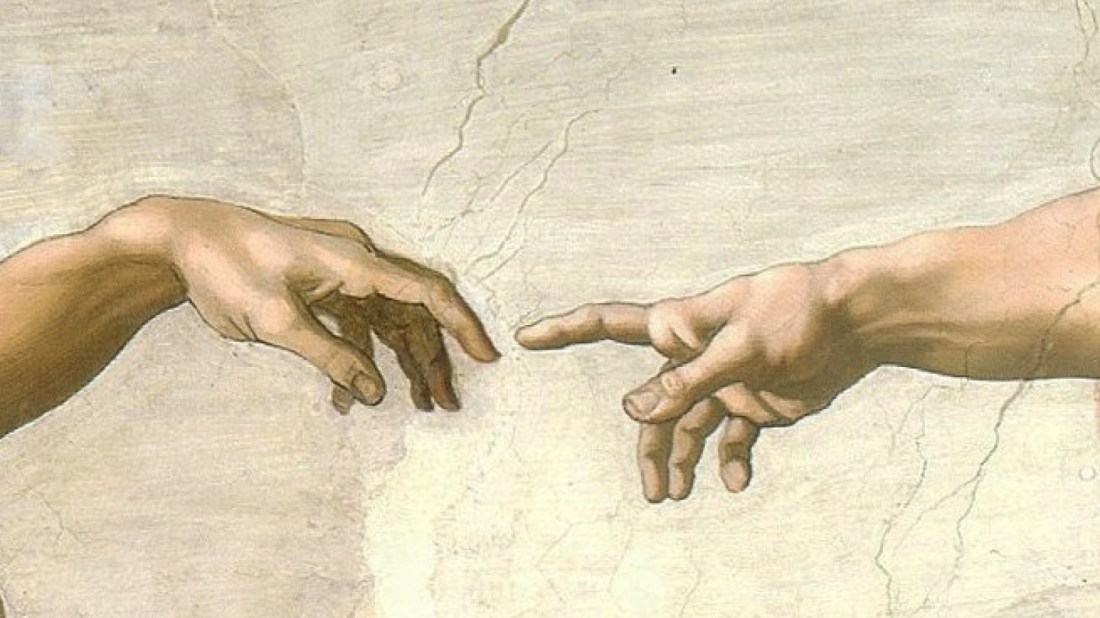
Watch on YouTube
The story of Jonah is a well-known favorite. It’s a tale of a whale… and it’s also whale of a tale.
The book of Jonah is only four short chapters. And although the whale looms large in our thoughts, it’s actually a very small part of the story. There’s one verse at the end of chapter one:
Now the Lord had arranged for a great fish to swallow Jonah. And Jonah was inside the fish for three days and three nights. (Jonah 1:17)
Chapter 2 is Jonah’s prayer from inside the great fish, and then this one verse:
Then the LORD ordered the fish to spit Jonah out onto the beach. (Jonah 2:10) Thus ends the whale’s part in the story.

The whale is the most fun part of the story…but there’s something fishy about it. This picture is from a Bible I got for Christmas this year entitled “Incredible Creatures & Creations.” It tells about the fantastic creatures mentioned in the Bible, and the myths and ideas that developed over the centuries about those creatures.
About the whale it says us that “the original Hebrew word in Jonah’s story only means ‘great fish’ or ‘big fish.’ Later, when the Old Testament was rewritten in Greek, translators chose [the word] cetus, a term closely related to sea monsters and sea serpents. By the time the King James version of the Bible was translated, cetus was a word mostly used for whales.”
Most species of whale eat tiny fish, so probably would not swallow big ‘ol Jonah. Early church illustrations of this story show Jonah with an enormous water dragon, something more like this picture.
Another fishy thing about Jonah is that we tend to focus on the first three chapters of the story, and on Jonah’s disobedience and then repentance.
God tells Jonah: “Get up and go to the great city of Nineveh. Announce my judgment against it because I have seen how wicked its people are.” (Jonah 1:2)
But what does Jonah do? Jonah gets up and heads in the opposite direction. Nineveh was in what is now Iraq. But Jonah heads for Tarshish, which may have been in what is now Spain, or might just be a way of saying he was headed for somewhere far away.[2]
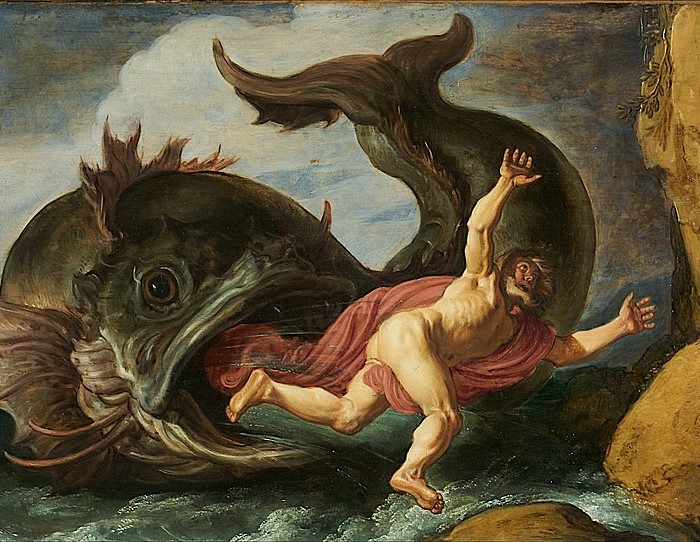
Then the great fish spit Jonah out onto the shore, and God gave Jonah a second chance by repeating the call: “Get up and go to the great city of Nineveh, and deliver the message I have given you.” (Jonah 3:1) So Jonah went to Nineveh and stood on a street corner shouting “Forty days from now Nineveh will be destroyed!” (Jonah 3:4) And the people believed the message and turned from their wicked ways.
Jonah has become a common metaphor for running away from God. We applaud Jonah for his transformation in the belly of the great fish and for his obedience. But what if that reading misses the point? How obedient was Jonah really? In chapter four we see Jonah sulking, sitting on a hill overlooking the city, watching to see whether God will destroy Nineveh. God doesn’t, and Jonah is angry. And that’s basically where the book ends.
In the Connections Commentary, John Holbert points out that “the book of Jonah is a satire, skewering prophets who can go bad. The author had a whale of a good time attacking those who claim to know God but whose actions are far from God’s desires.”
Holbert says that our first clue is that Jonah’s name means “dove of faithfulness.” Sounds like a good name for a prophet, but it’s not an accurate description of Jonah who seems more intent on faithLESSness.
Another bit of fishiness is Jonah’s prayer from inside the great fish. It’s not exactly a prayer of repentance. Jonah blames God for his “great trouble.” He says, “You threw me into the ocean depths,” “you have driven me from your presence.” But is it God’s fault that Jonah’s in trouble? No.
And if the prayer doesn’t quite seem to make sense, that might be because it’s a stringing together of verses from the Psalms. (31:6, 42:7, 42:6, 119, 31:7). He ends with a vow from Psalm 31:7:
“But I will offer sacrifices to you with songs of praise,
and I will fulfill all my vows.
For my salvation comes from the LORD alone.”
But we never see Jonah offer sacrifices to God. It’s the sailors on the boat that offer sacrifices to God. The sailors started out the journey worshiping their pagan gods, but they have been changed by their experience with the storm and with Jonah, and have become worshipers of Yahweh.
Likewise, the Ninevites, when they hear Jonah’s message “declared a fast and put on burlap to show their sorrow.” The entire great city is changed by Jonah’s message. If only all prophets had such wonderful results!
But Jonah is not happy at all. In fact, he’s very angry and he complains to God:
“Didn’t I say before I left home that you would do this, LORD? That is why I ran away to Tarshish! I knew that you are a merciful and compassionate God, slow to get angry and filled with unfailing love. You are eager to turn back from destroying people. 3 Just kill me now, LORD! I’d rather be dead than alive if what I predicted will not happen.” (Jonah 4:2-3)
Jonah didn’t want to go to Nineveh because he didn’t want to be rescuing his enemies from destruction. In his complaint, Jonah quotes God’s own words from Exodus 34:5-6 when God passes before Moses and reveals the glory Moses wanted to see. God’s glory is that God is merciful and compassionate, slow to get angry and filled with unfailing love. That’s a beautiful thing! But not to Jonah. Jonah would rather be dead than see his enemies survive.
So, yes, Jonah did do what God told him to do, but only after he nearly died running away from God’s call, and only because God is merciful and gave Jonah a second chance. Jonah has obeyed grudgingly, and he’s terribly angry with God about it.
That being the case, is this really a story about a prophet’s obedience?
Doesn’t God tell us to love our neighbors as ourselves? And Jesus tells us to love our enemies, whoever they may be.
Hobert suggests that Jonah is a story about how “so-called prophets” who say the right things can harbor hatred in their hearts but they cannot stop the powerful love of God.
Sort of like what Paul says in his letter to the Philippians, that even if some are preaching with selfish motives and impure hearts, it doesn’t matter because either way the Good News of Jesus Christ is being preached. (Phil 1:17-18)
Or what the Angel Gabriel tells Mary in Luke 1:2, “the word of God will never fail.”
We can only speculate about why Jonah hates the Ninevites. Maybe he resents the actions of their leaders. We know from 2 Kings 19 that King Sennacherib of Assyria came and threatened to destroy Jerusalem. King Hezekiah and all the Israelites were afraid, so they dressed in burlap and called out to God to rescue them. God did, and King Sennacherib went home to Nineveh.
But Nineveh is a big place. The book of Jonah says it took three days to walk across. That’s probably about 120 miles, bigger than Washington D.C., almost as big as Detroit. That’s a lot of people to hate.
Obviously God doesn’t hate Ninevites, though, since God sent Jonah to call them to turn to God. God is the creator of everyone and everything. God created Jonah and God created the Ninevites.

Genesis 1:27 tells us that humans are made in the image of God. Imago Dei is Latin for the image of God.
But it doesn’t seem like Jonah sees the Ninevites as people who are God’s creation. This is a human tendency that the book of James points out:
With the tongue we praise our Lord and Father, and with it we curse human beings, who have been made in God’s likeness. — James 3:9
Who exactly has been made in God’s likeness? Is it every single human being? Or only those who have a relationship with God? Or only those who have been ordained into God’s calling as leaders? What is the image of God in us?
Scholars have debated this for centuries. Theologian Karl Barth said that the verses in Genesis 1 about being created in God’s image don’t focus on any one specific part or aspect of humanity. Ancient Hebrews didn’t think of a human being as being separate parts – mind, body, soul. Those ideas came much later in Greek philosophy. So instead, according to Hebrew Bible scholar Claus Westermann, Genesis is speaking of the person as a whole. We should note that God is not male or female or human like us. John Wesley taught that the image of God in us is in our spiritual being, our understanding, our stewardship of all of life, and our ability to have relationships with God and one another. Maybe the image of God in us is God’s love.[5]
Have any of you seen the Veggie Tales movie “Jonah”? Do you remember what the sin of Nineveh was in that movie? Slapping each other in the face with fish. (They may have borrowed the fish idea from Monty Python.) It sounds silly, but the Bible doesn’t tell us what exactly Nineveh was doing. I like the choice to make it slapping each other with fish because it’s a funny way of saying they were treating each other badly.

Imago Dei is an important concept for how we view and treat other people. If everyone is made in the image of God, then how could we treat anyone badly? Unfortunately, we do. It is deeply ingrained in us through our culture that some people are better than others because of their race, their position, their economic status, their gender, or orientation.
In the magazine Scientific American there was an article a few years ago about undoing racism. [6] The writer, Abigail Lister, told about an “Undoing Racism” workshop she attended because she wanted to gain a better understanding of why some people have so much contempt toward those who are different from them. The workshop began with the participants sharing their answers to the question, “What is racism?” The leaders listened to their answers and pointed out that few of them had identified racism as a web of institutional power and oppression based on skin color. They explained that one of the reasons racism is hard to undo is that our understandings of it are so varied, and it’s important that we see how racism is a power hierarchy. Our economy is a power hierarchy.
It’s complicated but maybe also simple. Do you know about the golden rule? “He who has the gold makes the rules.” Unfortunately, all too true, and why racism is perpetuated in our country through systems of power.
What is the golden rule in the bible? Jesus said, “Do to others whatever you would like them to do to you. This is the essence of all that is taught in the law and the prophets.” (Matthew 7:12)
Changing racism and systems of power comes not only through intellectual understanding, but also through emotional connection. Our relationships matter. Love matters. Jesus gave us a mandate: Love one another as I have loved you.
It’s been said that we will never look into the eyes of someone God doesn’t love.
Jonah himself pointed this out. He said to God, “You are a merciful and compassionate God, slow to get angry and filled with unfailing love. You are eager to turn back from destroying people.”
And then God asked Jonah, “Is it right for you to be angry about this?” (Jonah 4:4)
Essentially that’s where the book ends. Should we be angry that God loves people who are not like us just as much as God loves each one of us?
If we’re going to get angry, let’s get angry enough to work for changing the systems that discriminate and exclude people.
With God’s help, we can.
Thanks, God.
[1] NIV Incredible Creatures & Creations Holy Bible, Zonderkidz (an imprint of Zondervan, 2018), Illustrations by David Malan of MB Artists.
[2] https://en.wikipedia.org/wiki/Tarshish
[3] Image by Pieter Lastman – IAFT8IfCTfplRQ at Google Cultural Institute maximum zoom level, Public Domain, https://commons.wikimedia.org/w/index.php?curid=24208288
[4] Pic of painting by Michelangelo – Creation of Adam, Sistine Chapel, Public Domain, https://commons.wikimedia.org/w/index.php?curid=71427942
[5] Austen Hartke, Transforming: The Bible and the Lives of Transgender Christians, Westminster John Knox Press, 2023 edition, pgs. 61-64.
[6] Abigail Libers. “How to Unlearn Racism.” https://www.scientificamerican.com/article/how-to-unlearn-racism/ Accessed January 21, 202. This article was originally published with the title “How to Unlearn Racism” in Scientific American Magazine Vol. 323 No. 4 (October 2020), p. 26 doi:10.1038/scientificamerican1020-58

 United Presbyterian Church