


Watch on YouTube

Is there a person in your life who is the go-to person when you need something because they almost always have whatever it is you need? When my children were young, I carried a backpack so that I could have all the things we might need – wet wipes, Kleenex, bandaids, snacks, pacifiers, toys, swiss army knife, scissors, tape, markers, crayons, paper, just to name a few. But to fit everything in, I kept having to get bigger backpacks or bigger bags.

It would have been really handy to have a bottomless bag….like the one Mary Poppins had, or the one Hermione had in the Harry Potter series.
Hermione sorta cheats, though, because her bag was bottomless from a spell she put on it. Hermione uses an “undetectable extension charm” so that she can carry a huge tent, several books, clothes, really just about anything.[1]

In The Deathly Hallows, Hermione and Harry are living in a tent that she had brought in her bag. A full-size tent comes out of her small bag, and the tent itself is bigger on the inside, with multiple rooms, beds, tables, chairs. All of this, of course, was intense (in tents).

This idea of an unending resource is also found in the Pixar animated movie Inside Out. In this movie, all the characters are the emotions and imaginations inside the head of a girl named Riley. The bottomless bag is the property of Bing Bong the pink elephant who is Riley’s imaginary friend. Joy asks to borrow it to save some memory globes. It’s a small, purple drawstring bag (kind of like Hermione’s) that can hold everything including the kitchen sink. Joy actually finds a kitchen sing in there. And before Joy can put her memory globes in, Joy has to let a cat out of the bag. A real cat.[2]
In Dungeons and Dragons, the endless resource could be a Bag of Holding[3] or a coat with many pockets. Maybe you know of other games, books, movies, TV shows or plays that use this idea.
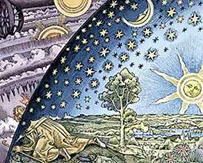
It’s the tent in today’s scripture that got me thinking about Hermione’s bottomless bag. Isaiah 40:22 says that God “stretches out the heavens like a curtain and spreads them like a tent to live in.” Of course, Isaiah was written long before airplanes or rockets to the moon. In Isaiah’s time the skies seemed like a dome covering the earth, or a heavenly veil[4] between us and God. I like the idea of the sky as a tent, and how it puts God in perspective as the one who can do more than we can ask or imagine, as Paul says in Ephesians.
The writer of Isaiah is speaking words of comfort to the Israelites living in captivity in Babylon. They’ve been there awhile, and they’re losing hope that they will ever leave, so God has commanded Isaiah in first verse of chapter 40: Comfort, O comfort my people, says your God. Speak tenderly to Jerusalem…
The people in Babylon are grieving all that was lost when “King Nebuchadnezzar of Babylon came to Jerusalem and captured it…” (2 Chronicles 36:6). Homes, buildings, and the temple were destroyed, many people were killed, and many were taken as prisoners to Babylon. They desperately needed comfort as they mourned the loss of friends, family, livelihood, possessions, and, they imagined, their connection with God.
Isaiah uses the image of God spreading the heavens out like a tent to answer his own rhetorical questions in verse 21:
Have you not known? Have you not heard?
Has it not been told you from the beginning?
Have you not understood from the foundations of the earth?
In other words, have you forgotten who God is?
God is the one who created everything, who is more powerful than the rulers of the earth, and is able to blow them away like dead grass.
The Israelites in Babylon feel forgotten and far away from God in the midst of their suffering. So Isaiah reminds them that no one is equal to God who created the stars, and that though there are millions of stars, God knows each one and not one is missing. Similarly, God knows each one of the people and has not forgotten any of them. Wherever the people are, they can look up at the stars and be reminded that God is bigger than any of their challenges and God has not abandoned them.
What helps you remember who God is?
James Cone, the author of Black Theology, wrestles with the question of who God is in light of the ungodly acts a society performs in the name of God. Cone says that “oppressed and oppressors cannot possibly mean the same thing when they speak of God. The God of the oppressed is a God of revolution who breaks the chains of slavery,” but the oppressors’ God is a God of slavery…” So Cone decides that “the question then…is not whether blacks believe in God, but whose God?”
Cone reminds us that “all human beings have a sense of the presence of God, a feeling of awe, and it is precisely this experience that makes them creatures who always rebel against domestication. The black community is thus a religious community…that views its liberation as the work of the divine.”
Cone points out that the God of the Bible is the God of the oppressed. “God has been revealed in the history of oppressed Israel and decisively in the Oppressed One, Jesus Christ, so it is impossible to say anything about God without seeing God as being involved in the contemporary liberation of all oppressed peoples.”[5]
So, in other words, we know who God is and we see God’s presence through God’s acts of liberation, and especially in God’s liberation of those who are oppressed. Just like Isaiah is speaking to the Israelites who are being held captive by their Babylonian oppressors, Cone is speaking to blacks being oppressed by whites in America, but also Cone’s theology of liberation gives hope to anyone who is poor or exploited or outcast.
Therefore, Cone says that the church is called to proclaim “the reality of divine liberation, the gospel as revealed in Jesus Christ and the outpouring of the Holy Spirit…to proclaim the good news of freedom and to share in the liberation struggle.”[6]
How have you seen God setting people free?
In our reading from Isaiah we are seeing a prophet bringing words of hope to a people in the midst of hopelessness and despair. The last three verses of today’s reading are some of the most hopeful and encouraging words in the Bible.
The Lord is the everlasting God,
the Creator of all the earth.
He never grows weak or weary.
No one can measure the depths of his understanding.
29 He gives power to the weak
and strength to the powerless.
30 Even youths will become weak and tired,
and young men will fall in exhaustion.
31 But those who trust in the Lord will find new strength.
They will soar high on wings like eagles.
They will run and not grow weary.
They will walk and not faint.
In verse 31 we see a theme that comes out again and again in the book of Isaiah:
“,,,those who trust in the Lord will find new strength.”
Isaiah is reminding us that God is trustworthy and faithful. This knowledge gives us hope and renews us. Overall theme of Isaiah is that it is the single-minded trust in God and God’s never-ending love that helps us in our struggles.[7]
When we are weighed down by hopelessness, trust in God renews our hope and our strength so that we will “soar on wings like eagles.”
Rev. Otis Moss III, in his book Blue Note Preaching, tells a story that has been passed down through the ages among the people of the Low Country of South Carolina who are descended from Transatlantic Africans. If you’ve heard this story, you might have heard it differently, since according to Moss, no two people tell it quite the same.
“The tale begins on the island of St. John, as displaced Africans who had been mislabeled as slaves toiled in the hot sun under the devious watchful eye of a nameless slave driver. Among this group of coffee black, mocha brown, and caramel colored people was a woman tending her child and picking cotton. She had such dexterity that she could pick cotton with her right hand and caress the forehead of her child with her left. She was…exhausted from the pressure of working in the hot, humid conditions, when her body gave out under the stress and…she collapsed.
The boy, who could have been no more than six or seven, attempted to wake his mother…knowing that if the slave masters were to witness this sudden stop in work, punishment would be swift and hard.
The slave drivers noticed that the woman had fallen…and they climbed their beasts of burden to ride to the place where she had disappeared…but before the drivers could reach her, an old man came over to the woman who had fallen. The people called him “Preacher” or “Prophet” but the slave master called him “Old Devil.” The little boy looked into the kind face of this old man and simply asked, “Is it time?” The old man just smiled and nodded and uttered one work in the woman’s ear and the same word into the boy’s ear, “Kulibah!” The woman miraculously gained strength when the word entered her ear and landed on her spirit. As a matter of fact, the other Africans stopped working to witness the birth of a queen, for at that moment she rose from the ground. She looked toward the slave drivers who were riding on their beasts of burden toward her, and she looked at her son. She grasped his hand; they both looked up toward Heaven and began to fly. The slave drivers lost their composure, unable to process this idea of human flight.
During their brief moment of disbelief, Preacher ran to the other slaves and told them, “It’s time!” He began to utter, “Kulibah, Kulibah, Kulibah!” The Africans rose from the fields and their flight to freedom began. Can you imagine this sight; the dehumanized flying, three fifths of a person flying, the disenfranchised flying, the dishonored flying, the disempowered flying, the discouraged flying…All taking flight with such grace and beauty to a world no one had yet seen.
The slave drivers grabbed the old man and beat him to within an inch of his life. They interrogated him, but the more they beat him the more he smiled…The slave masters demanded that he bring back the slaves. The old man just looked at them, smiled, and simply said, “I can’t. Once the word is in them, it will never leave them.”
The old man was given an ancient word. He was the steward of the mysteries. The word Kulibah originated on the shores of West Africa and literally means “God is in you.” He did not create it, he just spoke it. The prophet did not keep the word…he just passed on to someone else the word that was given to him…He passed on the word so that someone else could be freed by this word.[8]
The preacher in the story is doing for the slaves what Isaiah is doing in his words to the people in exile, giving them hope, giving them life, renewing their trust in God. Upon hearing words of hope, their souls take flight.
What makes your soul take flight?
Sort of like the bottomless bag, God is our endless source of hope and grace and love and strength, who calls us to do more than we can hope or imagine “or request in our wildest dreams! He does it not by pushing us around but by working within us, God’s Spirit deeply and gently within us. To God be glory in the church and in Christ Jesus throughout all generations forever and ever. Amen (Ephesians 3:20-21)
[1] https://www.wizardingworld.com/features/10-of-the-most-useful-objects-from-the-wizarding-world
[2] https://disney.fandom.com/wiki/Bottomless_Bag
[3] https://tvtropes.org/pmwiki/pmwiki.php/Main/BagOfHolding
[4] http://www.mysterium.com/veil.html
[5] James Cone, A Black Theology of Liberation, Fortieth Anniversary Edition, Kindle version, pg. 63-65.
[6] Ibid, pg. 121.
[7] Paul D. Hanson, Interpretation: Isaiah 40-66, Westminster John Knox Press, 1995, pg. 32.
[8] Rev. Otis Moss III, Blue Note Preaching in a Post Soul World, Westminster John Knox Press, 2015, Kindle version, pp. 22-24.

 United Presbyterian Church