


Watch on YouTube
What’s in a name? Just about all the names in the Bible have meaning. I’ve often wondered whether the name had that meaning at the time it was given, or did the name come to have that meaning because of the character of the person to whom it was given.
For example, in today’s scripture reading, Jesus changes Peter’s name from Simon to Peter. The name Peter means “rock.” Jesus recognized that Peter was the boulder disciple.
Today’s sermon title, “Praise the Mount,” comes from the words of the hymn “Come Thou Fount of Every Blessing.” The whole line says, “Praise the mount, I’m fixed upon it, mount of Thy redeeming love.” What’s the “mount” we’re praising?
In our hymnal, the words are slightly different: “Praise his name I’m fixed upon it, name of God’s redeeming love.”
To whom are the words “His name” referring? To me, both ”the mount” and “his name” point to Jesus.
Jesus has many names – Savior, Lord, King, Prince of Peace, the Word of God made flesh, Emmanuel, the Lamb. In Rev 22:13 Jesus says, “I am the Alpha and the Omega, the First and the Last, the Beginning and the End.” And in Rev 22:16 “I am the bright morning star.” According to Crudens Concordance, there are 198 different names for Jesus in the Bible!
All of these names refer to some aspect of Jesus or remind us of something God has done through Jesus.
What does the name Jesus mean to you? This is in essence the question Jesus is asking the disciples when he asks, “Who do you say that I am?” (Matt 16:15)
Simon Peter replied, “You are the Christ, the Son of the living God.”
The terms “Christ” and “Messiah” both mean “anointed one.” “Christ” is Greek, “Messiah” is Hebrew. And both those names are full of historic significance and expectation. The Old Testament prophets spoke of a savior from the line of David who would come to rescue the Jewish people from the oppressive occupation of the Romans and restore David’s dynasty to its former glory. They expected the Messiah to bring an unprecedented era of peace, righteousness and prosperity.[1] To some, the term “Christ” meant Jesus would be the fulfillment of their nationalistic and political hopes.”[2]
What did it mean to Peter? Peter says “Christ” but also “Son of God.” This says that Peter is seeing Jesus as more than a political leader. “Son of God” means Peter also sensed that Jesus was divine.
Jesus praises Peter for his insightful response. “Blessed are you, Simon Bar-Jonah! For flesh and blood has not revealed this to you,)but my Father who is in heaven.” (Matt. 16:16).[3]
Why does it matter who we say Jesus is? One reason is that following Jesus can cause us to have to make some tough decisions.
In Matthew 19, When Jesus was talking with the rich man about what he must do to be saved, Jesus told the man to sell all his possessions, give the money to the poor, and come follow him. The rich man went away sad, because he had many possessions. Then Jesus tells the disciples that it is easier for a camel to go through the eye of a needle than for a rich person to enter the kingdom of God.
The disciples are amazed at this and ask, “Who, then, can be saved?”
Jesus replies, “For humans, this is impossible, but with God all things are possible.”
Peter speaks up then, asking, “We have left everything to follow you! What then will there be for us?”
28 Jesus said to them, “Truly I tell you, at the renewal of all things, when the Son of Man sits on his glorious throne,(G) you who have followed me will also sit on twelve thrones, judging the twelve tribes of Israel.(H) 29 And everyone who has left houses or brothers or sisters or father or mother or wife[a] or children or fields for my sake will receive a hundred times as much and will inherit eternal life.(I) 30 But many who are first will be last, and many who are last will be first.” (Matt. 16:20-30)
In following Jesus, we too may find we need to leave things behind like Peter and the disciples did. I hear Peter’s grief in his statement that they have left everything behind. One day in seminary, the professor read this verse and I felt like God was saying to me, “I have seen your sacrifices for me, and I understand your sorrow.” When I am missing family and friends that I have left behind, this verse comforts me a bit.
Who do you say that Jesus is and why does that matter to you?
After Peter makes his statement of faith, “You are the Christ, the Son of the Living God,” Jesus makes a rather mysterious statement:
18 And I tell you, you are Peter, and on this rock I will build my church, and the gates of hell shall not prevail against it. 19 I will give you the keys of the kingdom of heaven, and whatever you bind on earth shall be bound in heaven, and whatever you loose on earth shall be loosed in heaven.”

What are the keys and what will be bound and loosed?
ßhere are the keys of the kingdom. (Rob Krabbe says it’s a blues progression in E.)

Larry Helyer, in his book about Peter says that “Peter’s keys[4]…likely refer to his authoritative role within the new covenant community.” Helyer says the idiom of binding and loosing would then refer to legal decisions regarding badly behaved members of the community.[5]
But I think that reading is too authoritarian and legalistic. What if Jesus meant that we all have the power to offer people love and grace. Our behavior as Christians goes beyond our relationship with Jesus. Our words and actions affect the people around us, and can be perceived as a reflection of the one we are supposed to be following. Paul says:
For God was in Christ, reconciling the world to himself, no longer counting people’s sins against them. And he gave us this wonderful message of reconciliation. (2 Corinthians 5:19)
We all make decisions that have consequence to other people, sometimes without realizing it. I was surprised when I first decided to go to seminary to find that his tdecision affected not just me, but also my family and friends, and my church, because they took on the charge to be my caregivers and shepherds.
I once knew someone who was so afraid of God that she would not go inside a church building because she had been told that God hates people who are LGBTQ. That is not a message of reconciliation! Nor is it God’s intent. But the message of hate had sunk in so deeply that she couldn’t believe that God would love her.
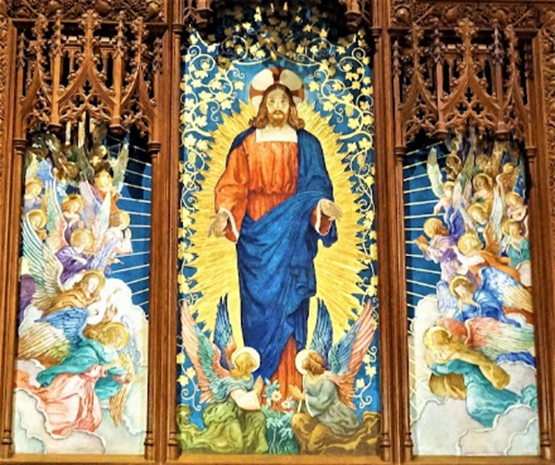
Diana Butler Bass in the introduction to her book “Freeing Jesus” tells about an experience she had while praying in a chapel at the Washington National Cathedral that changed her perception of who Jesus is and what following Jesus meant. She says:
“My knees hurt. The cushion at the marble altar almost did not matter. I could feel the cold in my legs, the ache of unanswered prayers. “Where are you, God?” I asked.
Silence.
I looked up at Jesus in full triptych glory, surrounded by angels, robed in cobalt blue against a gilt background, shimmering sanctity. The small chapel in the great cathedral was one of my favorite places to pray, mostly because of this Jesus. Today, however, I was restless as I gazed intently at the massive icon of Christ. Usually, the image drew me deeper toward God, and the railing where I knelt was a place of awakening and wisdom. “Where are you, God?” I asked again.
Silence.
“God?” A quiet plea, really, the most incomplete of prayers.
“Get me out of here,” a voice replied.
Was someone speaking to me? I looked behind, around.
“Get me out of here,” the voice said again. I stared up at the icon. “Jesus? Is that you?”
“Get me out of here,” I heard again, more insistent now.
“But Lord . . .”
The chapel fell silent, but I know I heard a divine demand for freedom. I was not sure what to think, but I also did not want to tell the priest who was wandering up the aisle. I doubted the Washington National Cathedral would take kindly to the Son of God looking for the exit. And I was not sure what to do. Smuggling an altarpiece out of the building was not going to happen. Instead, I got up and nearly bolted out, all the while envisioning how I might rescue Jesus from the cathedral. I felt bad leaving him behind.[6]
Looking back on that event, ten years later, Bass says, “My husband still laughs about ‘that time Jesus asked you to spring him from the slammer.’” She hesitates to share the story because, she says, “well, you just never know how people will respond to a voice from heaven—or a talking painting—requesting parole from church. Truthfully, I did not know how to respond.”[7]
How would you respond? Our answers to that question might be different depending on who we say Jesus is.
Our understanding of who Jesus is changes and grows throughout our lives as we have different experiences of Jesus. The times in which we’re living will also impact our understanding.
When we gather together to worship and praise God, celebrate Jesus, and give thanks for all that God has given us, the Holy Spirit moves among us, reminding us of who Jesus is, and all that has happened to bring us into this current time and place. The Holy Spirit strengthens us in our faith, and gives us courage to profess and proclaim the love of God shown to us all through Jesus Christ, and carry that love out into the world through all that we do and say. We will not always be the best witnesses, but we are also blessed by God’s grace, so that we can try and fail and try again, to the Glory of God.
Thanks, God.
[1] 2 Sam 7:14-17; Is 11; Jer 23:5-8; Ezek 34:23-31
[2] Helyer, Larry R.. The Life and Witness of Peter (p. 41). InterVarsity Press. Kindle Edition.
[3] Ibid., (p. 42).
[4] Photo by Nerene Grobler on Unsplash
[5] Helyer, Larry R.. The Life and Witness of Peter (pp. 44-45). InterVarsity Press. Kindle Edition.
[6] Bass, Diana Butler. Freeing Jesus: Rediscovering Jesus as Friend, Teacher, Savior, Lord, Way, and Presence . HarperCollins. Kindle Edition.
[7] Ibid

 United Presbyterian Church