


Psalm 1
VIDEO: https://bibleproject.com/explore/video/psalm-1/
Watch on YouTube
Have you met Bob? Bob has been all over the internet offering wise advice about all sorts of behaviors.

This is Bob.
Bob doesn’t talk bad about people behind their backs.
Bob knows it will hurt their feelings.
Bob is kind.
Be like Bob.
To me, Psalm 1 sounds a little like those Bob memes.

This is Tree
Tree doesn’t walk with the wicked
Or stand with the sinners
Or sit with the mockers
Tree meditates on God’s word day and night.
Tree is good.
Be like tree.
Maybe this sounds like something an adult might say to a child. “Why can’t you be more like your sister?” (I’m sure my brother heard that a lot.)
No, just kidding. The reality is that we’re each unique creations, and all of us are made in the image of our creator. Psalm 1 isn’t calling us to be who we’re not, it’s calling us to be who we are.
Of all the psalms, I think Psalm 1 is extra special. For one thing, it’s about a tree. You may already know that I like trees. I just can’t leaf them alone. And I’m not the only one. I think God likes trees too, because the Bible is framed by trees.
In the beginning, in Genesis 2, the Garden of Eden is full of trees, and especially these two trees:
… In the middle of the garden he placed the tree of life and the tree of the knowledge of good and evil. (Genesis 2:9)
In the Garden of Eden, these trees were watered by a river.
At the end of the Bible, in Revelation 22, in the description of the new Jerusalem, there is a river, just like in Genesis.
On each side of the river grew a tree of life, bearing twelve crops of fruit, with a fresh crop each month. (Revelation 22:2)
Two trees of life – one on each side of the river, constantly bearing fruit, symbolic of God’s abundant blessings. At the end of time, all of creation is renewed and redeemed.
The tree in Psalm 1 reminds us, here in the middle of the Bible, that this is what the Bible is all about – living life with God who is always with us. We are God’s people and we are renewed by streams of water that flow through us by the power of the Holy Spirit, through Jesus, from God.
“…like a tree planted by streams of water,
which yields its fruit in season and whose leaf does not wither…” (Psalm 1:3)
Not just survival life, but prosperous life. Thriving life. Life that blesses others.
In John 7:38 Jesus says, “Whoever believes in me, as the Scripture has said, ‘Out of his heart will flow rivers of living water.'”
Just by being who we are, reflections of God’s goodness, we are a blessing. Like a tree. A tree seems to just stand there, but while it’s just standing there, its leaves are turning carbon dioxide into oxygen, and providing shade from the heat of the sun. Its roots are helping the soil, and its branches are providing homes for birds and squirrels and monkeys and all sorts of other creatures.
“Trees are poems that the earth writes upon the sky.”
— Kahlil Gabran, Lebanese-American writer and poet
Like trees, we can be a silent presence and at the same time be praying for those around us, and listening to those who need to tell somebody about what’s happening to them.
Psalm 1 uses trees to remind us of the goodness of God’s wisdom. The book of James talks about how that goodness is reflected in our lives:
If you are wise and understand God’s ways, prove it by living an honorable life, doing good works with the humility that comes from wisdom . . .But the wisdom from above is first of all pure. It is also peace loving, gentle at all times, and willing to yield to others. It is full of mercy and the fruit of good deeds. It shows no favoritism and is always sincere. (James 3:13,17 NLT)
Both James 3 and Psalm 1 get a bit fruity…by which I mean they talk about the fruit we produce as a result of God’s goodness in us. Verse 3 of Psalm 1 says that people who live a Godly life will find that “whatever they do prospers.” One of the lessons of Psalm 1 is how we measure success. What does it mean to prosper? We’re conditioned by our culture to think that success means bigger numbers – more people – bigger bank accounts – more stuff. But it goes deeper than that.
“There was once a minister who began as most church planters did, calling together a core team to meet regularly. They devoted time every day to be together to form friendship and community. In time, this gifted preacher began to speak more often and the community began to draw more and more people. Miracles also began to occur where people were healed and delivered from demonic powers.
“But this young minister tended to avoid the limelight. He would serve and then withdraw to rest and pray, even from his core team. He spoke truth to power and even truth to those who wanted to idolize him. Within two years his popular base grew to the point where they wanted him to enter into politics but he declined and walked away.
“His continued resistance to popularity and power caused his base to dwindle to almost nothing in the third year. Those who had high hopes for his work and ministry moved on. One of his inner circle saw the writing on the wall, betrayed him to his detractors and at the point when his enemies came to take him down, his core team abandoned him. It was assumed that he was nothing more than a flash in the pan. He could have applied better church planting strategies and leveraged his popularity or charisma. But the day after his being betrayed and abandoned by those closest to him, he was crucified.
“Jesus didn’t follow our modern church growth models, but he is our model for ministry. He is our Lord.”[2]
The Psalm 1 tree is prosperous because it does what it’s made to do – stay close to God’s word and produce fruit. And each tree produces the kind of fruit it’s made to produce. The apple tree produces apples. The maple tree produces sweet sap for syrup. The cottonwood tree sends its fluffy seeds out on the wind.

Psalm 1 just talks about a single tree, but, like people, trees do better when they’re with other trees in community. They maintain their individuality, allowing each other to be who they are, but at the same time, they help each other thrive.
Writer and researcher Peter Wohlleben has found that trees live longer when they’re with other trees because they establish a more consistent climate and help protect each other from wind and weather, moderate the extremes of heat and cold, store more water, and generate more humidity. Every tree is valuable to the community because gaps leave the other trees more vulnerable.[3]
Being a part of a community is important for us as people, too. We help each other survive, and thrive.
Our denomination, the Presbyterian Church (PCUSA) has encouraged congregations to become more engaged in our world through the Matthew 25 initiative which focuses on Matthew 25: 31-46, the parable of the sheep and goats, in which Jesus makes clear that what we do matters to God and how we treat others is important to God.
“Whenever you did it for any of my people, no matter how unimportant they seemed, you did it for me.” (Matthew 25:40 CEV)
Part of being a Matthew 25 church is that we’re not just focused on enjoying life with God, but we’re also paying attention to how our neighbors are getting along. We’re working on being a place where everybody can be themselves and feel welcome and encouraged.
What are some of the things that we do to serve our community?
One of the biggest things we do for our community is host the Lil Cubs Daycare. We invested in remodeling this facility as a mission to our community. This happened a few years before I came here because Dr. Tom Simpson brought the idea to our session, and they took a risk and said yes. That willingness to take risks for God’s mission was one of the things that attracted me to this church.
The daycare went through some rough years during the pandemic, as so many organizations did. Now they’ve had a fresh start with the new director Jaime Welch who came on board a few months ago. They’re focused on having dedicated teachers who love kids, an excellent facility, expanding preschool offerings, new curriculum, new activities, and providing a safe, loving, nurturing environment. Jaime points out that the daycare not only supports working parents, but is also laying the foundation for the next generation. Our continued support of the daycare enhances and enriches that mission.
This is one of the best ways we offer ministry to our community. We made a big investment in having it, and we need to continue to support and minister to them. What are some ways we could help the daycare know that we welcome and encourage them?
Just because we’re here with a building in an easily accessible place, we make a difference by being who we are. We are hosting a day care. We are offering food in our little pantry. What else can we do? People who walk by might appreciate a place to sit and rest. We have space outside to add seating. A labyrinth. We have space inside to offer gathering places.
We have the art group meeting here on Wednesdays. Carol Gardner would like us to offer an art group for kids this summer. Would you be willing to help her with that?
What are some other ways we could help our community?
Let’s do all we can to live out our call to be who we are, reflections of God’s abundant goodness and grace in this time and place.
Maybe it’s just as simple as being like trees. What kind of tree would you like to be?
Thanks, God.
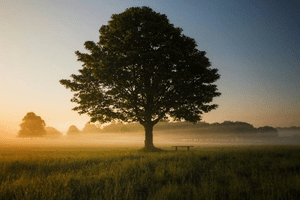
[1] Photo by Simon Wilkes on Unsplash
[2] Adapted from https://f3c.ca/f3c/resources/pastoralarticles/the-genius-of-the-small-church/
[3] Peter Wohlleben, The Hidden Life of Trees: The Illustrated Edition, Greystone Books: 2015, pp. 11-12.

 United Presbyterian Church