

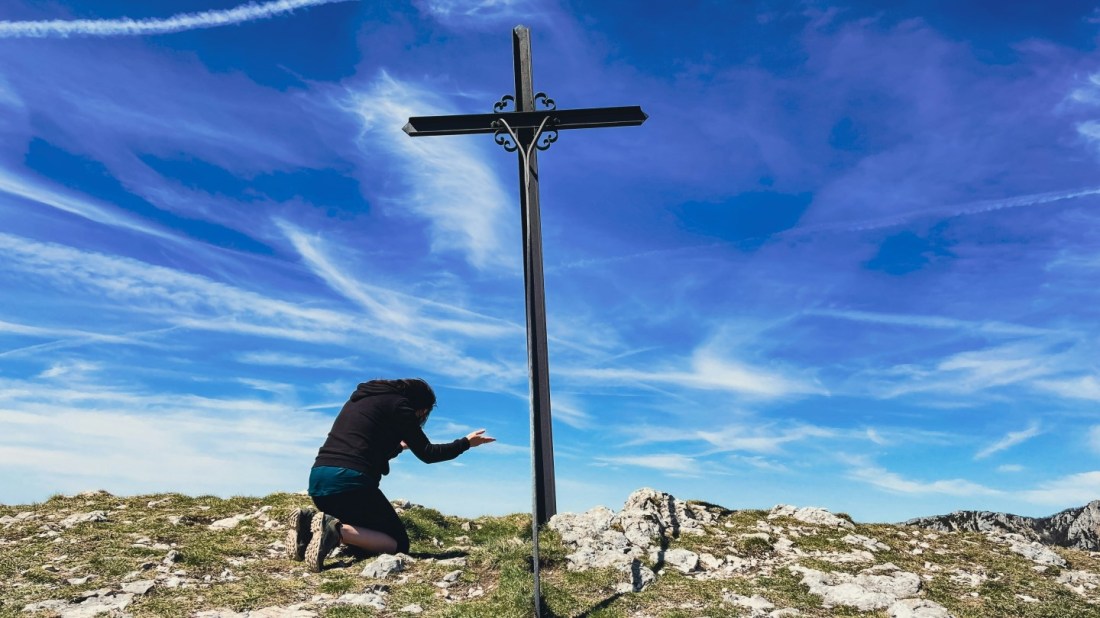
Watch on YouTube

Today we’re talking about justice, a word that can mean different things to different people. When I was a kid, I thought justice meant this:
- If you break a rule, there’s going to be a punishment.
- If you do something mean or bad to your brother, you’re going to have to apologize…
…and then there would be punishment.
I would much rather have served a punishment than have to apologize to my brother.
Punishment often meant having to go to my bedroom. (Which also meant I’d have to clean it up while I was in there.) Being sent to my room was kind of like being in the mushpot. Like in the game Duck-Duck-Goose. If you get tapped on the head and chase the runner around the circle and don’t catch him or her before they sit in your spot, then you have to sit in the center of the circle, the mushpot.
The mushpot was a form of punishment…which is why I think it’s funny that mushpot sounds so much like the Hebrew word mishpat which means justice. As in:
Micah 6:8 “He has shown you, O mortal, what is good. And what does the LORD require of you? To act justly and to love mercy and to walk humbly with your God.”
To act justly or to do justice is mishpat. It means: To make good judgments, wise decisions. Divine judgements. To put things right.
In verse 8 of our Bible story for today, Zacchaeus the tax collector promises to put things right.
Zacchaeus . . . said, “I will give half my wealth to the poor, Lord, and if I have cheated people on their taxes, I will give them back four times as much!” (Luke 19:8)
There are a few unanswered questions in this story.
- Is Z’s statement in verse 8 the equivalent of an apology? Some say yes, some say no. What do you say?
- Is Z’s statement in verse 8 the reason Jesus says, “Today salvation has come to this house, because this man, too, is a son of Abraham”? Or was Z already correcting past wrongs?
Does salvation require apologies? Does salvation require putting things right? Or does salvation simply require Jesus?
These are all good questions, and each one of us might answer them differently. You might have different questions.

Z is maybe most famous for climbing a tree. (My office is called Zacchaeus’ Treehouse.) Z climbed a tree so that he could see over the crowd and get a glimpse of Jesus as he’s walking through Jericho.
Z needed to climb the tree because he was too short to see over the crowd.
If I were writing this story, I would definitely have made Z short, because it’s so perfect that the man who is the chief tax collector should come up short.
Zacchaeus is the real-life illustration of what Jesus was teaching in the previous chapter of Luke.
In Luke 18, Jesus tells a parable about a Pharisee and a tax collector who both have gone into the temple to pray. The Pharisee’s prays, “God, I thank you that I am not like other people: thieves, rogues, adulterers, or even like this tax collector.” But the tax collector’s prayer is, “God, be merciful to me, a sinner!” Jesus said that it was the tax collector who was made right with God through his prayer, and added that “all who exalt themselves will be humbled, but all who humble themselves will be exalted.” Zacchaeus is a tax collector who has humbled himself by climbing a tree to see Jesus.
In Luke 18, Jesus also talks about receiving the kingdom of God like a little child. Zacchaeus is excited to see Jesus, much like a child would be, and climbs a tree, something children are more likely to do.
In Luke 18, Jesus talks to a rich man who asks, “What must I do to be saved?” Jesus tells the rich man to give all he has to the poor. The rich man goes away sad, unable to do what Jesus asks. Jesus tells the disciples that it is easier for a camel to go through the eye of a needle than for a rich man to enter the kingdom of heaven. Zacchaeus is a rich man who gives half of his money to the poor.
In Luke 18, Jesus meets a blind man and asks the man what he wants. The blind man says, “I want to see,” and Jesus gives him sight. Zacchaeus, in climbing the tree, is also saying, “I want to see,” and Jesus gives Zacchaeus sight, too.
You may have noticed in today’s story that the people in the crowd have their own ideas about Zacchaeus. The story says that Zacchaeus quickly climbed down and took Jesus to his house in great excitement and joy. But the people were displeased and grumbling. “He has gone to be the guest of a notorious sinner.” (Luke 19:6-7)

Notorious Z.[1]
I think it’s sad, though not surprising, that the people in the crowd pay no attention to Z’s excitement and joy at being called out by Jesus and given the honor of having the best dinner guest ever. They’re grumbling, just like the Israelites in the desert in the Exodus were grumbling, and missing out on the bigger picture.

A pastor named Leith Anderson tells about being a boy growing up outside of New York City. Like many boys at that time, he was an avid fan of the Brooklyn Dodgers. He normally only listened on the radio, but one day his father took him to see a game between the Dodgers and the Yankees. It was 1956 and game 5 of the World Series. Leith was so excited to be there, and he just knew the Dodgers would trounce the Yankees. Unfortunately, the Dodgers never got on base the entire game, and his excitement was shattered.
Years later, in a conversation with a man, Leith told him about the first major league game he attended and added, “It was such a disappointment. I was a Dodger fan’ and the Dodgers never even got on base.”
The man said, “You were there?! You were at the game when Don Larsen pitched the first perfect game in all of World Series history!”[2] Leith replied, ”Yeah, but uh, we lost.” But then he realized that he had been so caught up in his team’s defeat that he missed out on the fact that he had been a witness to a far greater page of baseball history.
We may be missing the bigger picture about what’s happening beyond our focus. What is Jesus doing in our community? Is God pitching a perfect game in the world series of our neighborhood and we simply are missing out because we are so invested in our own team?[3]
We tend to focus on Zacchaeus without considering that he was representing the Roman government. When he talks about changing his taxation practices, he’s going against what was normal for tax collectors in that time. He’s part of a bigger system, and also part of the bigger picture of what Jesus was about.
Jesus tells us why he’s having dinner with Zacchaeus. He says, “For the Son of Man came to seek and save those who are lost.” (Luke 19:10)
Similarly, in John 3:17 Jesus says “For God did not send His Son into the world to condemn the world, but to save the world through Him.” Jesus doesn’t condemn Z. Jesus forgives him.
Sometimes we’re more inclined to be like the servant in the parable Jesus tells in Matthew 18:

23 “…the Kingdom of Heaven can be compared to a king who decided to bring his accounts up to date with servants who had borrowed money from him. 24 In the process, one of his debtors was brought in who owed him millions of dollars. 25 He couldn’t pay, so his master ordered that he be sold—along with his wife, his children, and everything he owned—to pay the debt.
26 “But the man fell down before his master and begged him, ‘Please, be patient with me, and I will pay it all.’ 27 Then his master was filled with pity for him, and he released him and forgave his debt.
28 “But when the man left the king, he went to a fellow servant who owed him a few thousand dollars.[l] He grabbed him by the throat and demanded instant payment.
29 “His fellow servant fell down before him and begged for a little more time. ‘Be patient with me, and I will pay it,’ he pleaded. 30 But his creditor wouldn’t wait. He had the man arrested and put in prison until the debt could be paid in full.
31 “When some of the other servants saw this, they were very upset. They went to the king and told him everything that had happened. 32 Then the king called in the man he had forgiven and said, ‘You evil servant! I forgave you that tremendous debt because you pleaded with me. 33 Shouldn’t you have mercy on your fellow servant, just as I had mercy on you?’

Forgiveness is what the Good News of Jesus is all about, and yet it can be hard to pass on the grace we have received.
[4]On October 2 2006, ten Amish girls were shot in their schoolhouse in Nickel Mines, Pennsylvania. Five died and five survived – and their families immediately bestowed their forgiveness. The attacker preyed on the most innocent and defenseless members of a peaceful religious community. Within hours, the Amish announced they had forgiven him.[5]
The crime was horrific, but the Amish forgiveness made headlines just as much.
The shooter had already killed himself, so he wasn’t there to receive their forgiveness, but the Amish people brought that forgiveness to the shooter’s widow. The day of the shooting they brought her food, and six days later they attended the shooter’s funeral. They shared the money that poured in afterwards with her.
They demonstrated what God did for us in Jesus Christ. Psalm 103:10 says, “God does not treat us as our sins deserve or repay us according to our iniquities.”
We learn as children that if we can’t run fast enough playing Duck-Duck-Goose, we’re going to end up in the mushpot, but God doesn’t put us in the mushpot. God gives us mishpat.
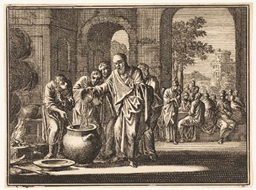
The word mushpot isn’t in the Bible, but there is a story about a stew pot, which if it was cooked long enough would have become a pot of mush. It’s in 2 Kings 4. Elisha and the group of prophets in Gilgal were making stew. One of the men went outside to pick some herbs to season the stew, and found some fruit on a vine, so he picked that fruit and added it to the stew along with the herbs. When they tasted the stew, they shouted out, “Man of God! There’s poison in the pot!” The food tasted like poison, so they could not eat that food.
But Elisha said, “Bring some flour.” He threw the flour into the pot. Then he said, “Pour the soup for the people so that they can eat.” And there was nothing wrong with the soup. (2 Kings 4:38-41) Elisha rescued them from death like Jesus rescues us.
We can only guess what that fruit was, and why they thought it tasted like poison, but it reminds me that

for a few hundred years people thought tomatoes[7] were poisonous.
in the late 1700s, in Europe the upper class people ate tomatoes off pewter plates and often got sick and died. But the cause of death was actually because of the high lead content of their pewter plates. The acidic tomato leached lead from the plate, which, when consumed, caused lead poisoning. People blamed the fruit rather than the pewter plates.[8]
Over time, the fear dissipated as scientific knowledge grew, and now tomatoes are one of the most commonly eaten kinds of produce. Just imagine life without spaghetti or pizza?!
Our understanding of the world has evolved, just like our understanding of God and the Bible evolves as we grow. We don’t put people in the mushpot anymore like we did when we were kids, and hopefully we get better at apologizing and forgiving. We also grow in our understanding of how our actions affect the people and the world around us.
Zacchaeus’s encounter with Jesus wasn’t just about Zacchaeus. It impacted the entire community, so much so that we’re still hearing about it over 2000 years later. That makes it sound huge and complicated, but Micah makes it simple:
Do justice, love mercy, and walk humbly with your God.
Thanks, God.
[1] Photo by Miloš Trajković on Unsplash
[2] http://www.baseball-almanac.com/box-scores/boxscore.php?boxid=195610080nya
[3] Brett Blair, www.Sermons.com (As told by Dean Register in the Minister’s Manual, 1995, 339)
[4] Photo by Ivan Aleksic on Unsplash
[5] Joanna Walters https://www.theguardian.com/us-news/2016/oct/02/amish-shooting-10-year-anniversary-pennsylvania-the-happening
[6] https://www.lookandlearn.com/history-images/YR0147446/Elisa-makes-the-poisoned-mush-pot-good-food
[7] Photo by Avin CP on Unsplash
[8] https://www.rd.com/article/are-tomatoes-poisonous/#:~:text=The%20acidic%20tomato%20leached%20lead,Italian%20herbalist%20Pietro%20Andrae%20Matthioli.

 United Presbyterian Church