


By Rev. Melissa Krabbe
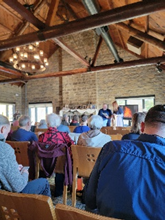
This past week I was up in Nebraska City, NE at the Arbor Day Foundation’s retreat center at a conference on storytelling for pastors. As you might expect, we worshipped together at the beginning and end of each day, and the liturgy and scripture readings all centered around the Bible’s stories.

The best part, though, is that we had workshops with coaches from The Moth. How many of you are familiar with The Moth? This is the same group that does the NPR radio show and does storytelling events around the country. It’s called The Moth because the man who started it, George Dawes Green, used to sit on the porch of his house and tell stories with his neighbors, and at night moths would be flying around them attracted to the light.
The coaches from The Moth helped us each craft our own compelling stories, and then they picked five pastors to tell their stories to the entire group of about 100. One of the people
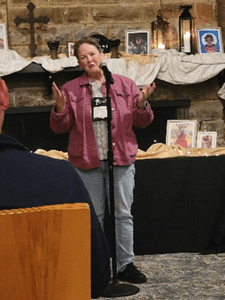
who got picked to tell their story was my roommate! This is Tammy Rider. She’s the pastor of two little churches in Rochester, MN. She told us about how she helped save the library in their neighborhood when she was about twelve years old.
I wish we could ask the widow in today’s scripture reading to tell us her story.
Today’s reading starts with Jesus teaching in the temple, and the first thing he says is “beware.” Beware of those scribes in their long robes. They like to show off. What really grabs my attention is the verb “devour.” They devour widows’ houses.
Are these scribes literally eating houses? Probably not, unless the houses are made of gingerbread, like in the story of Hansel and Gretel.
It’s a play on words. Jesus says the scribes like to have the
“…places of honor at banquets! They devour widows’ houses…”
So we might imagine the that at those banquets they are feasting on “Casa de Widow, medium rare.”[1]
What do you eat when you’re so hungry you could eat a house?
You eat …cottage… cheese. (Would you eat it with log cabin syrup?)
Pastor Carol Howard Merritt asks some good questions about this story in her commentary. She says, “When I come to this week’s passage from Mark, I sit next to Jesus and watch the crowd of people giving to the treasury. I see the widow, wondering what motivates her to give her two last copper coins. Where does this extraordinary sense of generosity come from? How did she learn to give, even to the detriment of her survival?”[2]
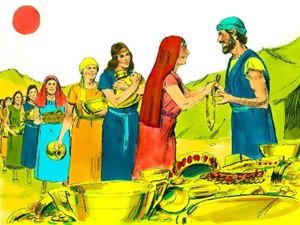
Any organization that isn’t selling something relies on donations to survive. One of the instructions that Moses gave the people of Israel during their forty years in the wilderness was that whenever they came to worship God, whenever they gathered together before God, that they should not come empty handed, but should bring something to give as an offering.
The practice of bringing offerings to our worship gatherings has continued down through the ages, and those offerings are part of what sustains the church. I say “part of” because in our case, and this is true for some other churches as well, we use our savings accounts to cover the gap between what we spend and what’s given in the offering each week. Most of our savings was a large gift from Anna Smisor Smith when she died back in the 90’s. We also have moneys that were memorial gifts given by the Aiken family, Carol Froese, and friends and family of Ed Jones, just to name a few. We are thankful for these people and their generosity. Thanks be to God!
Our current offerings cover about 80% of our expenses. I don’t know who gives and who doesn’t. I don’t know how much anyone gives. Only our treasurer knows that. But I am thankful for your giving and for your participation in the life of this church.
Sometimes it might feel like nobody notices and nobody cares. Just like in our scripture reading, the big givers might expect to be celebrated, and the small givers may wonder if their gift is too small to matter.
But it does matter and God sees. Just like Jesus saw the widow.
“…she out of her poverty has put in everything she had, all she had to live on.” (Mark 12:44)
Her gift foreshadows the one Jesus would soon give—his life.[3]
You know the grace of our Lord Jesus Christ. Although he was rich, he became poor for your sakes, so that you could become rich through his poverty. 2 Corinthians 8:9 Common English Bible
Pastor T. Denise Anderson: “By lifting up the widow’s actions, Jesus is not simply heaping praise on her for her generosity; he’s indicting the system that keeps her poor. He’s asking us to face our greed. Everyone must ask themselves some tough questions. Is this right? Why is she down to only two coins of the lowest possible denomination? How did she get here, and did we let it happen?”[4]
The widow was one of the most vulnerable class of people in that time, but still she is required to pay the temple tax. She is at the mercy of the men in her family. When her husband died, she would need to move in with her eldest son, but if she had no son, or if her son was still a child, another family member would need to take care of her, and if there was no other family member, she would likely be destitute.
Who are the most vulnerable in our current time and place? Who are the people on the margins?
How do our systems contribute to poverty today?
Author James Baldwin says, “Anyone who has ever struggled with poverty knows how extremely expensive it is to be poor.”
Maybe you know the truth of Baldwin’s statement from your own experience.

When all you can afford to rent is a trailer, maybe if you’re lucky it’s a “fancy double-wide,” but the walls are thin and there’s little insulation, so it costs more to heat and cool than a stick-built house would. And there’s nothing you can do about it, even when you discover that part of the problem is that some critter has eaten through the ducting underneath the trailer. The landlord says he’ll get it fixed one of these days, but those days never seem to come.
In Texas, rental laws require that your rent only be one-third of your income. If you make $2500 a month (about $14.50 per hour), rent has to be less than $832.50, which severely limits the options available to you. It might mean that you have to live further away from your job, which then means a greater need for a car. It will have to be a used car, of course, but the usual dealers won’t work with you, so you have to go to an independent used car dealer where the interest rates are considerably higher, and where there is no grace for late payments, so not only will you never be able to pay enough to pay it off, you’ll lose all you’ve put into it the first time the payment is late and the car gets repossessed.
And of course there’s the cost of having an older car. It uses more gas, and it breaks down more often.
Poverty is indeed expensive.
There are some safety nets. Some people have family that can help in a pinch. Not everyone has that option. There are government programs, but not everyone is able to qualify. Some people get stuck in the gap between making too much to get help but not enough to make ends meet. If you have a disability and are unable to work, Social Security has a plan for that, but you might not be able to get through the application process without a lawyer, and not everyone has access to legal help.
We have made the commitment to be a Matthew 25 church which means we are seeking to help eliminate systemic racism and structural poverty. It’s a learning process, and we need to continue to help each other work on this, keep telling the stories that help us understand, and continue to ask God to help us see how the systems and structures need to change.
At the high school that I attended, there was a teacher who asked us to bring in song lyrics or poems to analyze and discuss. My husband Rob had this same teacher two years before me. Rob writes lots of songs and poetry, so he’d brought one of his own pieces to the class, and the teacher was so excited about Rob’s writing that he and Rob would meet after school to share songs and poems they each had written. So when it was my turn to bring in a song or poem, I brought one of Rob’s. The teacher recognized it right away, and when I told him that Rob and I were dating, I instantly gained good standing with that teacher.
One of the fun things about Rob’s writing is that he will sometimes choose words for how they sound, taste, or feel to say, as much as for what they mean. It makes them nice to read out loud or sing, and leaves room for people to find their own meaning.
Example:
But listen, Linda . . .
We’re getting to the juice.
The rub. The nub. The cerebral hub.
Loosen up, take a breath, buckle in.
Here comes the spark of ambivalent genius!
If a lone dark rider on a
beautiful leather saddle
and a well-rested steed,
tromped through the
mutual mental landscape,
of my pathetic need to feed,
this brain, that does nothing
but complain, about desperate
moments and old habits, well
a pint of mead, stat! Maybe that!
Just don’t tell me what I’d ought.
Someone has to stand up and lead us
to freedom, and the implications
of my life-long creed.[6]
Of course, Rob isn’t the only writer who does this. David Byrne of the Talking Heads is famous for song lyrics that fit the feeling of the song but don’t necessarily mean what we might think. For example, the song “Burning Down the House” seems to be about arson or protesting, but it’s more that the phrase fit the rhythm and melody that had already been written.
I thought of the phrase “burning down the house” as I was reading today’s scripture in Mark 12. The setting is similar to last week’s reading. Jesus is at the temple being challenged by the Sadducees and pharisees, all of that representing the existing institution of religion, the status quo. Jesus is an enigma and a challenge. He is, of course, quite adept at answering their questions, and then he turns to the crowd and says, “Beware of these teachers of the law who like to show off their fancy robes and have the best seats at banquets. They devour widows’ houses.” (Mark 12:38-40 MK paraphrase)
Devouring widows’ houses is not quite the same as burning them down—it’s more like wolfing them down, which is particularly appropriate since Jesus warns in the Sermon on the Mount in Matthew 7 to “Watch out for false prophets. They come to you in sheep’s clothing, but inwardly they are ferocious wolves.” (Matthew 7:15 CEB)
These wolves in sheep’s clothing were fleecing the widows, exploiting their vulnerability. And Jesus is condemning them for their greed and egotism.[7] They’re also exploiting her devotion to God.
Is that still happening? Any time we get people to do something by making them feel guilty or ashamed, we’re exploiting them. Is there a time when you, in a sense, burned down the house?
The most important part is that God sees. Jesus sees the widow putting in her two copper coins, and God sees whatever you do or don’t do and knows what’s going on in all of our hearts and minds and lives. Our words, thoughts and actions matter.
Thanks, God.
[1] Mark Davis, “Pretentious Pretenders Pressuring Penurious Pensioners,” Monday, November 1, 2021, https://leftbehindandlovingit.blogspot.com
[2] Carol Howard Merritt, “The Last Coin,” Christian Century, November 5, 2015 https://www.christiancentury.org/blogs/archive/2015-11/last-coin?utm_source=Christian+Century+Newsletter&utm_campaign=59c4614159-EMAIL_CAMPAIGN_SCFREE_2024-11-04&utm_medium=email&utm_term=0_-a11c3b8de1-%5BLIST_EMAIL_ID%5D
[3] Ibid.
[4] T. Denise Anderson, “Why is the Widow Poor?” Sunday’s Coming newsletter, November 10, 2024. Christian Century
[5] Photo by Documerica on Unsplash
[6] Rob Krabbe, “I Need a Good Stiff Think” https://www.facebook.com/rob.krabbe/posts/pfbid0BsH1YVUuHxGQ16yeSmExR67VvgUqyPkG57upigG6g3C3yS6xY1nBffWKjXTeZR5Kl
[7] Lamar Williamson, Jr. Interpretation: Mark, pg. 233.

 United Presbyterian Church