

By Rev. Melissa Krabbe
Watch on YouTube
Friday afternoon Bryson and Bekah Brownlee got married. One of the things Bob Brownlee told them in his remarks is that marriage can be difficult. So true. Maybe one of the hardest parts is learning to fight in a way that doesn’t tear the relationship apart. My husband Rob and I have been married for a very long time, but I still remember the fighting years. It got so bad that my mom gave us a book on fair fighting. The book had some good guidance for fighting respectfully and some that seemed crazy – like sitting facing each other with your knees touching while you argue. We tried it. It’s definitely harder to stay angry that way.
All couples will argue, and so will churches. The apostle Paul’s letters to the church in Corinth are a bit like that book my mom gave us. Paul was writing in response to arguments the church was having over things like which leaders were the best, how to keep people from hogging all the communion bread and wine, and whose spiritual gifts were the most important. That’s what prompted Paul to write the part we read today in which he urges the Corinthians to respect each other regardless of their gifts. They’re all important parts of the church, the body of Christ.
In verse 7, Paul tells why they’re all important. The Holy Spirit displays God’s power through each of us as a means of helping the entire church. (1 Cor 12:7 TLB) Whether the Holy Spirit is working through us in big or small ways, all of those ways help the entire church.
Today is Reformation Sunday, a day to remember the big ways the Holy Spirit was working through the reformers of the 16th century. The most famous is Martin Luther who wrote out his 95 arguments against the pope and nailed them to the door of the church in Wittenburg, Germany. But there were many others—Phillip Melanchthon, John Calvin, John Knox, and Huldrych Zwingli, to name just a few.
One you might not have heard of is Argula von Grumbach (1492-c.1554). She also put her complaints in writing, but instead of nailing them to a church door, she sent them to the faculty of the University of Ingolstadt where a student had been arrested for teaching Lutheran views and was being threatened with death (being burned on a stake). Ms. Grumbach was livid and eloquent. She cited over 80 scriptures in her letter. Back then women weren’t normally taught about the Bible because they thought it was too much for a woman to understand.
The university ignored Ms. Grumbach, but since this was just after the printing press was invented, her letter got printed. It was so popular that there were 14 editions. People wanted to see this phenomenon of a woman writing theology and challenging the leadership of a university. She continued to write and be published, to the chagrin of her husband who lost his administrative position because of his inability to control his wife. He didn’t, and her writing continued to be popular and to contribute to the spread of the reformation.
The Reformation was not the first big church split, but it is the one that led to the formation of the Protestant denominations, including ours. Despite all the divisions that have happened over the ensuing centuries, we are all a part of the body of Christ. Paul says in verse 12, “Just as a body, though one, has many parts, but all its many parts form one body, so it is with Christ.” (1 Cor 12:12).
Just like a body grows and changes, so it is with the body of Christ. Our Presbyterian constitution, the Book of Order, says that we are, “The church reformed, always to be reform[ing] according to the Word of God” in the power of the Spirit.[1] We continue to grow and change as the Holy Spirit works through us making us more and more like Jesus. Change is challenging and leads to arguments in which we need to respect each other.
That’s what Jackie Robinson requested. He said, “I’m not concerned with your liking or disliking me…All I ask is that you respect me as a human being.” He was the first African American to play major league baseball. In this picture he’s wearing the jersey of a minor league team, but in the major leagues he played for the Dodgers, the same team that won the first two games of the World Series this week, though in 1947 they were the Brooklyn Dodgers.
A Black player on a major league team might not seem like such a big thing now, but in the 1940’s it was huge. Racism was more blatant then, and the Civil Rights movement hadn’t yet begun. Robinson was a great baseball player who impacted the way the game was played, but who also stood up against racism before during and after his baseball career.”[2]
Robinson played an important part, but he wasn’t the only part. As Paul says, “A body isn’t just a single part blown up into something huge.” (1 Cor 12:14 MSG)
How weird would it be if the body was all a bunch of hands and no other parts? Or like Thing on the Adams Family and all there was was just one hand?
If the body was all eye, how could it hear? (1 Cor 12:17)[3]
We need the eyes AND the ears, along with the mouth and the nose.
Paul is using this analogy of the body to point out that all our different spiritual gifts are important. He lists some of them in verses 8-10:
- wise counsel
- clear understanding
- simple trust
- healing the sick
- miraculous acts
- proclamation
- distinguishing between spirits
- tongues
- interpretation of tongues.
In the Corinthian church, they were giving more respect to the gift of tongues, which is probably why Paul put it last on this list. There are still churches arguing about this today, some even saying that a person is not truly Christian if they aren’t able to speak in tongues.
Which of these gifts do you have?
Which of the gifts do we emphasize more or less today?
In my opinion we give too much importance to proclamation, not just because that is what pastors do, but also because we tend to listen more to the loudest voices.
Paul’s argument is that “All these gifts have a common origin, but are handed out one by one by the one Spirit of God.” (1 Cor 12:11) Every ability we have, every gift we have, everything we are comes from God. Because we all have different gifts and abilities, we have differing perspectives, and we need to be respectful of our differences.
No one gift can accomplish all that it takes to be the church. As Paul says, “It’s all the different-but-similar parts arranged and functioning together.” (1 Cor 12:14)
We see this most vividly in times of trouble and celebration. Paul says: If one part suffers, every part suffers with it; if one part is honored, every part rejoices with it. (1 Cor 12:26 NIV)
We experience this in our own bodies. When one part hurts, the tension created by the pain can make our whole body hurt.

We experience this in our congregation, United Presbyterian Church.

We are also part of the body of the City of Sterling.
When one part of the city suffers, it affects the whole city, and when one part of the city rejoices, everybody rejoices. It’s the same with the body of

the State of Kansas.
This particular map is showing which counties have the most diversity. The darker the color, the less the diversity. The blue counties are the most racially diverse. So although Rice County is less diverse, we might want to be sensitive to the reality that immigration is of vital importance to those blue counties. Which also means that the churches in those areas are more focused on ministry to immigrants.

In the body, if one part suffers, every part suffers. If one part rejoices, every part rejoices.
That’s true for the larger body, [5]the United States.
Right now the entire country is experiencing the tension around the election, and when the results come out next week, or in the weeks that follow, we need to be especially respectful of the reality that some of us will be rejoicing and some of us will be disappointed or sad or angry, and some will have ignored the whole thing, and some will be afraid of what might happen next.

The outcome affects more than just the United States. The whole world is watching and waiting along with us. And their perspective will be different than ours because they’re affected differently. Sometimes when I need some perspective, I find it helpful to google news from the BBC or Al Jazeera to see their top stories are, and to get their perspective on what’s happening in the United States. When their perspectives are different from mine, I could ignore them or decide they’re stupid, or I can respect that we’ve all got a variety of reasons for our views and understandings.
The reality is, and the point that Paul is making, is that we are not all the same but we are all of equal value. We are all worthy of respect and dignity.
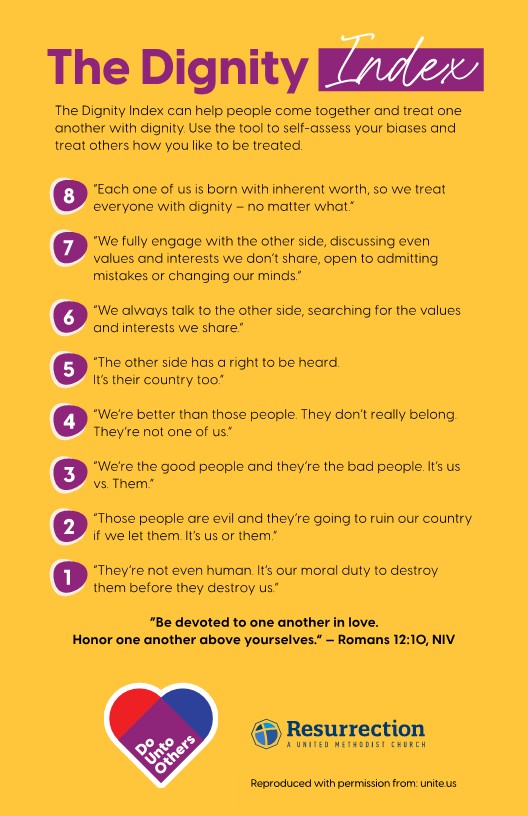
At the beginning of this series, this kindness campaign, we handed out this dignity index. It was created by Tim Shriver, a film producer and disability rights activist.
“The primary skill I believe we need in the 21st century is the capacity to think and feel and understand difference and not be scared of it.”
In some ways, we have two different worlds, the world in which we live and work and have relationships, and the world of politics and media where we hear things that divide us, like: “Those people are dangerous. Those people are trying to ruin our country. Those people have to be stopped.”
Shriver believes that we are today the most entrepreneurial, the most creative, the most open and welcoming of any generation in history, but we hear so much less about that and so much more about the differences that divide us. So he created the dignity index to help us disagree without being disagreeable, to have conversations and relationships in ways that show kindness and respect to one another.[6]
The index has eight statements that show varying degrees of respect. The least respectful, the bottom of the index says: “They’re not even human. It’s our moral duty to destroy them before they destroy us.”
That might sound unrealistic and extreme, but this is something that’s actually being said in some churches. Adam Hamilton, pastor of Resurrection Methodist Church in Kansas City, played a clip in his sermon last week of a pastor who told his congregation, “You cannot be a Christian and vote Democrat in this nation! They are God-denying demons that butcher babies!”
Hamilton points out that this is demonizing half of the United States population. He says, “If you listen to this rhetoric, …combined with scriptures taken out of context, anyone can be taught to fear and taught that those who think differently are a part of a vast network of evil doing the devil’s work. . . [Like in] Rwanda in 1991 where church-going Hutu were fed propaganda, lies, that their Tutsi neighbors were dangerous, were doing evil, and needed to be killed–-not unlike the Nazi propaganda in Germany. After three years of hearing this propaganda, from April to July of 1994, the Hutu, a majority of whom were Christians, murdered over 500,000 of their Tutsi neighbors with machetes.”[7]
That’s the ultimate in disrespect.
The top of the dignity index, the most respectful, says: “Each one of us is born with inherent worth, so we treat everyone with dignity – no matter what.”
That’s our goal. That’s the one that most reflects what Jesus taught us when he said we are to love our neighbors as we love ourselves, and to love one another as he has loved us. Jesus told us that God loved THE WORLD so much that he gave his only son for us all. Every one of us was worth dying for.
One way to work on having this perspective would be to ask God to help us see people through God’s eyes. You might have heard the song by Brandon Heath about this. He sings:
“Give me Your eyes for just one second
Give me Your eyes so I can see
Everything that I keep missing
Give Your love for humanity
Give me Your arms for the broken-hearted
The ones that are far beyond my reach
Give me Your heart for the ones forgotten
Give me Your eyes so I can see.”[8]
Seeing with God’s eyes helps us to see people as individuals who are worthy of love instead of as “those people.”
We are not all the same but we are all of equal value. We are all worthy of respect. Thanks be to God!
[1] Book of Order 2023/2025, F-2.02 THE CONFESSIONS AS SUBORDINATE STANDARDS “… Ecclesia reformata, semper reformanda secundum verbum Dei, that is https://www.pcusa.org/site_media/media/uploads/oga/pdf/boo_2023-2023_publishedversion_cover_and_boo_complete.pdf
[2] Josh Jackson, 2019, https://www.milb.com/news/jackie-robinson-first-made-his-mark-in-the-minor-leagues-301588624
[3] https://mythologyvault.com/mythic-beings/creatures/cyclops-one-eyed-giant-myth/
[4] https://en.wikipedia.org/wiki/Kansas#/media/File:Kansas_counties_by_race.svg
[5] https://en.wikipedia.org/wiki/Kansas#/media/File:Kansas_in_United_States.svg
[6] https://attheu.utah.edu/events/the-power-dignity-tim-shriver-forges-new-path-through-the-walls-that-divide-us/
[7] Adam Hamilton, sermon preached on October 20, 2024 at Resurrection Methodist Church, Kansas City.
[8] https://www.extremelove.com/2017/08/29/give-me-your-eyes-lord/

 United Presbyterian Church

