

By Rev. Melissa Krabbe
Today’s sermon title is from a famous quote: “With malice toward none…”
A little quiz:
- What is the rest of that quote? (with charity for all)
- Who said it? (Abraham Lincoln)
- Bonus question: On what occasion? (2nd inaugural address)
Fun facts:
- The date of Lincoln’s speech is March 4, 1865, only 41 days before his assassination
- and, just over 30 days before the Civil War would be officially ended on April 9,1865
- with General Lee’s surrender to General Grant at the Appomattox Court House.
Lincoln is speaking to a nation that has been embroiled in civil war for four long years.
- Brother has fought against brother.
- Over 620,000 people died in the Civil War.
- That’s almost as many as died in all the other wars combined. (640,000)

The need for reunion, reconstruction, and forgiveness was huge. So Lincoln urges, “malice toward none and charity for all.” Lincoln called on everyone “…to bind up the nation’s wounds; to care for him who shall have borne the battle, and for his widow, and his orphan—to do all which may achieve and cherish a just and lasting peace, among ourselves, and with all nations.”[3]
The divide over this war was so deep that even to this day, our nation is still not united over the cause of it. It grew out of Lincoln’s determination to keep new states that entered the union from being allowed to have slaves. When I was a student at Clemson University in South Carolina, I said something to a classmate about the war being over slavery. She immediately hushed me and admonished me not to say that out loud in public. To South Carolinians, it was a war over states rights, and while in their state, we dare not say otherwise.
In the midst of this deep division, Lincoln echoes God’s command through Jesus and the torah. “Love your neighbor as yourself.” (Matthew 22:39, Leviticus 19:18)
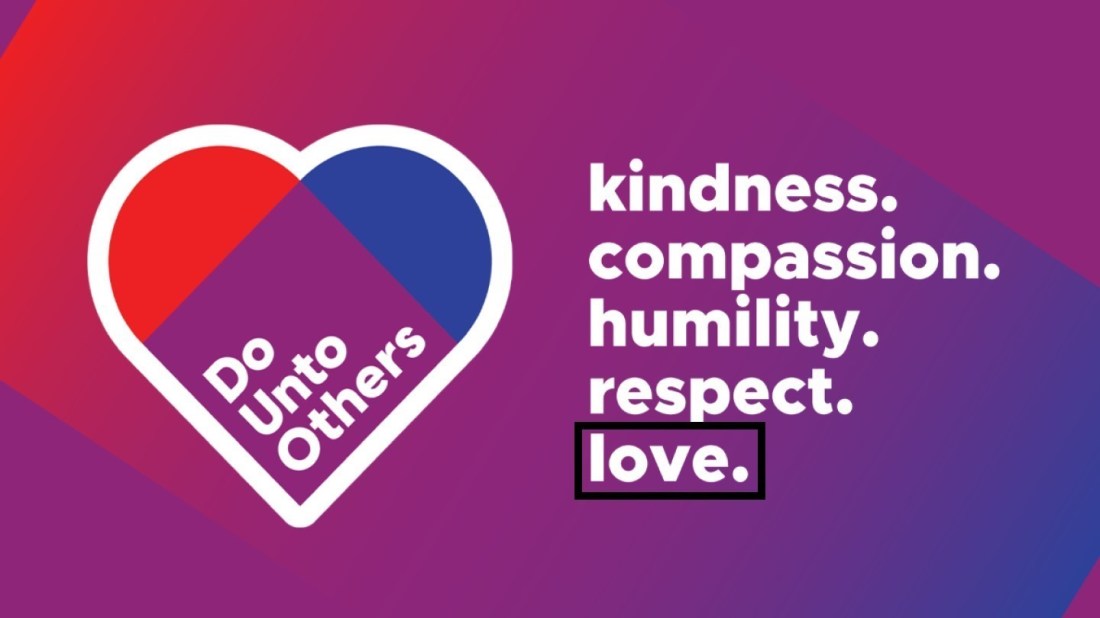
This is what we’ve been talking about for the last five weeks during our campaign for kindness – in the midst of division to have kindness and compassion, respect and humility, and love.
In the time that Jesus lived, there were also deep divisions and deadly power struggles going on. In the section of Matthew’s gospel we read today, Jesus is being challenged by the Sadducees and the Pharisees. These two groups were often at odds with each other, but united in their fear and distrust of Jesus. When one of them asks Jesus, “What is the greatest commandment in the law?” Jesus gives them an answer with which he knows they can’t argue. He quotes Deuteronomy 6:5, “Love the Lord your God with all your heart, all your being, and all your strength.”
And the second is like it, and also one with which they cannot argue since they know it well.
Leviticus 19:18 – You must not take revenge nor hold a grudge against any of your people; instead, you must love your neighbor as yourself; I am the Lord. (Common English Bible)
Love your neighbor. No revenge. No holding a grudge. After all, you are not a crow.
“If You Think You Can Hold a Grudge, Consider the Crow”

Did you know that crows hold grudges?[4] There was a story about murderous crows in the New York Times this week. Apparently crows will keep coming back to harass a person that has caused them harm or trauma. Their harassment is sometimes physical attacks, but sometimes just scolding. They will continue for years. A researcher at the University of Washington followed one for seventeen years. Some people found the only way to get rid of the crows was to move.[5]
Maybe that’s why a flock of crows is called a murder.
A woman was attacked by crows one day while she was out walking her dog. The next day she put peanuts in her pocket to throw to appease the birds. They kept following her, but there were no more attacks. And one day when a new crow did attack, the other crows protected her. So she keeps feeding them. She Says it feels like she’s paying them protection money.[6]
Maybe feeding the crows is a way to demonstrate loving our enemies, as Jesus said in Matthew 5. In Romans 12, the apostle Paul tells us to “Bless those who persecute you; bless and do not curse . . . Do not repay anyone evil for evil.” (Romans 12:14, 17-19)
Author and former pastor John Pavlovitz published an article last week entitled, “If God is Love, Why are Conservatives so Hateful?” Of course, not all conservatives are hateful, but it’s a catchy title. Pavlovitz proposes that the problem isn’t that people forget the two greatest commandments, but rather that they don’t pay enough attention to one of the most common ones, “Do not fear.” Don’t be afraid. I’ve said before I think angels say this because angels are big and scary. But Pavlovitz says that phrase is throughout the Bible because we’re so easily frightened. He writes,
“Christianity (embodied in the life and teachings of Jesus) was supposed to beautiful, joy-filling, and life-giving; a movement of compassion and mercy and forgiveness and sacrificial love.
It was supposed to be the most brilliant of lights in the pitch-black spaces where humanity often finds itself.
It was supposed to drive people to the places of deepest despair and greatest need, fully burdened to make their home there until the low are raised up, the hurting healed, and the captives freed.
It was also supposed to make people fearless.”[7]
Of course, there’s a lot that happens in the world that is scary. That’s one of the reasons we keep having to remind ourselves about God, and why we keep getting together to encourage one another – to remember to trust God. It’s why I have so many frogs (acronym Fully Rely On God) and why this is one of my favorite verses:
Isaiah 41:13 CEB I am the Lord your God,
who grasps your strong hand,
who says to you,
Don’t fear; I will help you.
God is holding our hands!

Pavlovitz says if we don’t actively work against the fear, our faith leaks out and we end up with a sort of “Frankenstein faith”[8] driven by fear instead of love.
And “…once that fear becomes the dominant force in your religion, you end up becoming more and more terrified, more desperate, more reactionary in your responses to the world in front of you. You grow increasingly hostile to those you perceive as outsiders, more intolerant of those who are different, more pulled toward a defense posture…In other words: You become less and less like Jesus.”
And maybe more and more like crows.
We need to remember that God’s love is deep and wide. In today’s reading the Greek word for love is agape which is the equivalent in the Old Testament of the Hebrew word hesed. Hesed and agape are words that mean so much more than simple love. On the banners behind me we have Psalm 106:1 “Give thanks to the Lord, for he is good; his love endures forever.” The three words “love endures forever” are the translation of the one Hebrew word hesed, expressing that God’s love is so inherent to who God is that God’s love will never go away, will never fail. God’s love is the equivalent of loyalty, and faithfulness. There is no person and no thing that is more worthy of our trust than God.
God’s love is God’s covenant with us. Like the covenant we make in marriage to love one another faithfully.
It’s that deep, forever covenant love that holds us together and allows us to transcend our differences.
New York Times columnist David French wrote a piece this week in which he says he understands the partnership between Kamala Harris and Liz Cheney partnership because it’s like his own connection with the group of friends he made in college. They have stayed connected in various ways over the years, even though they don’t agree about many things. They argue about politics. They argued about the Iraq war, but when French enlisted, they supported him, even got t-shirts with his name on them, and sent his whole unit care packages. In law school their friendship was sort of a marriage of convenience. But long after law school was over, they continued to be friends. French says:
“But 33 years later, our shared values have kept us together — a commitment to truth and compassion in our dealings with each other, a respect for open debate and honest inquiry, an underlying humility that told us that we needed to hear opposing views because none of us is perfect and a willingness to be able to live with disagreement without surrendering to bitterness or anger.”[9]
I hope you have friends like that. Maybe your family or your marriage is like that. I hope we can be those kinds of friends for one another.
Let’s makes it a priority.
Most important of all, continue to show deep love for each other, for love makes up for many of your faults. 2 Peter 4:8 The Living Bible
None of us is perfect. We don’t have to agree about everything. We just need to keep on loving and trusting God, and loving our neighbors through kindness, compassion, respect, and humility, just like Jesus told us and showed us, and left us the Holy Spirit to help us.
Thanks, God.
[1] Rev. Melissa Krabbe, preached on November 3, 2024 at United Presbyterian Church of Sterling, KS
[2] https://www.battlefields.org/learn/articles/civil-war-facts#:~:text=The%20war%20began%20when%20the,%2C%20on%20May%2013%2C%201865.
[3] https://en.wikipedia.org/wiki/Abraham_Lincoln
[4] Photo by Pixabay: https://www.pexels.com/photo/black-crow-in-macro-photgraphy-87078/
[5] Thomas Fuller. “If You Think You Can Hold a Grudge, Consider the Crow.” https://www.nytimes.com/2024/10/28/science/crows-grudges-revenge.html?unlocked_article_code=1.Wk4.1tN-.VNiJxP7hf-vD&smid=url-share
[6][6] Ibid.
[7] John Pavlovitz, October 21, 2024. “If God is Love, Why are Conservatives so Hateful?” https://johnpavlovitz.substack.com/p/if-god-is-love-why-are-conservative?utm_source=substack&utm_medium=email&utm_content=share
[8] By Universal Studios, NBCUniversal – Dr. Macro, Public Domain, https://commons.wikimedia.org/w/index.php?curid=3558176
[9] David French, “The Harris-Cheney Partnership Is Not Just a Marriage of Convenience,” October 31, 2024. https://www.nytimes.com/2024/10/31/opinion/kamala-harris-cheney-trump.html?smid=nytcore-android-share

 United Presbyterian Church